King County Property Tax Assessment Errors – Are Average Homeowners Overpaying?
- Ryan Palardy,
- September 2, 2026



By Ryan Palardy, Get Happy at Home Group at Compass | August 2026
If you own a modest home in King County, there is a good chance you are paying property taxes on a value higher than your home is actually worth, while the owner of a much more expensive home nearby pays taxes on a discount. That is the short version of what we found when we compared roughly 39,000 recent home sales across King County to the assessed values the county had assigned those exact homes.
The sale of a home is the one moment we know precisely what it is worth: a willing buyer and a willing seller agreed on a price in the open market. Washington law says the assessor’s job is to value every home at 100 percent of that market value, uniformly. So we asked a simple question: when homes actually sell, how close was the county’s number, and does the answer depend on the price of the home?
It does. Consistently, measurably, and in some neighborhoods dramatically.
Mostly, but not for everyone, and not everywhere. Across all resale homes sold in King County from January 2024 through August 2026, assessments show a small but persistent tilt: the less expensive the home, the higher its assessed value relative to what it actually sold for. On the industry’s own fairness test (the IAAO price-related bias standard used by assessors nationwide), King County lands just outside the acceptable range for this period.
The county-wide tilt is modest. What is not modest is what happens when you zoom in.
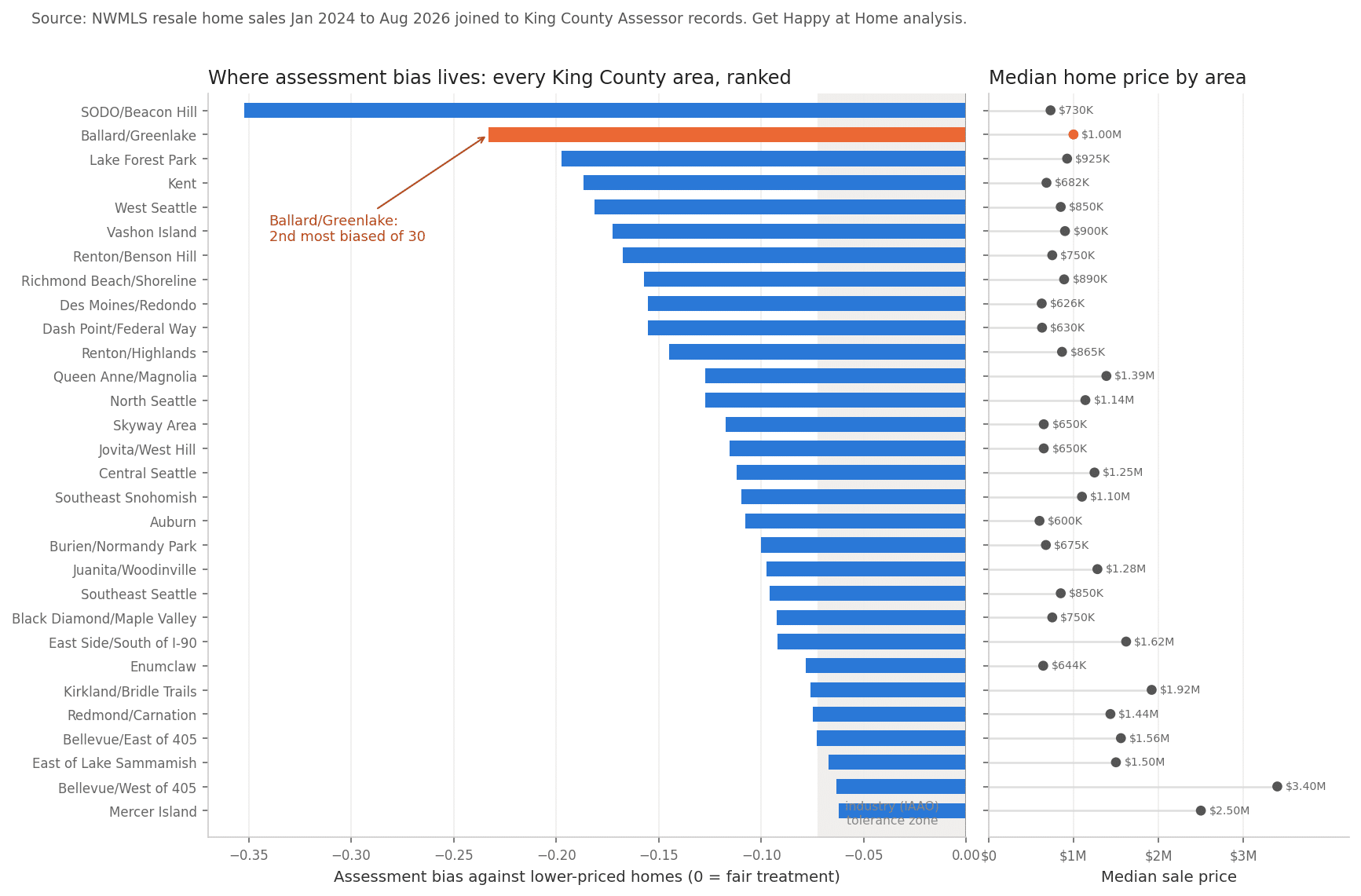
King County areas ranked by tax assessment “unfairness”
The cheapest ones. Among the least expensive 10 percent of homes sold (median price around $510,000), the county’s assessed value came in ABOVE the actual sale price 28 percent of the time. For the most expensive 10 percent (median around $2.7 million), that happened only 10 percent of the time.
Read that again: buy a $500,000 home in King County and there is better than a 1 in 4 chance the county claims it is worth more than anyone was willing to pay for it. Buy a $2.7 million home and it is 1 in 10.
In dollar terms, the typical home in the cheapest fifth of the market pays roughly $275 more per year than it would if every home paid taxes in proportion to its market value. The typical home in the most expensive fifth pays roughly $590 less. And because Washington property taxes are budget based (each taxing district collects a fixed total, and rates simply divide that total across all assessed value), the county does not gain or lose a dollar from any of this. The share not paid by under-assessed homes is quietly shifted onto everyone else. Owners of modest homes are, in effect, covering part of the tax bill for owners of expensive ones.
We ranked all 30 NWMLS market areas in the county by how strongly their assessments tilt against lower-priced homes. The results surprised us.
The most biased areas are not the richest or the poorest. They are the mixed, urban, in-city neighborhoods:
The five most biased areas are SODO/Beacon Hill, Ballard/Greenlake, Lake Forest Park, Kent, and West Seattle. In SODO and Beacon Hill, 44 percent of entry-level buyers purchased homes assessed above their sale price. In Ballard and Greenlake, it was 37 percent, and the typical entry-level home (around $675,000) overpays its proportional share by roughly $680 per year while the typical top-tier home (around $1.65 million) underpays by roughly $1,035.
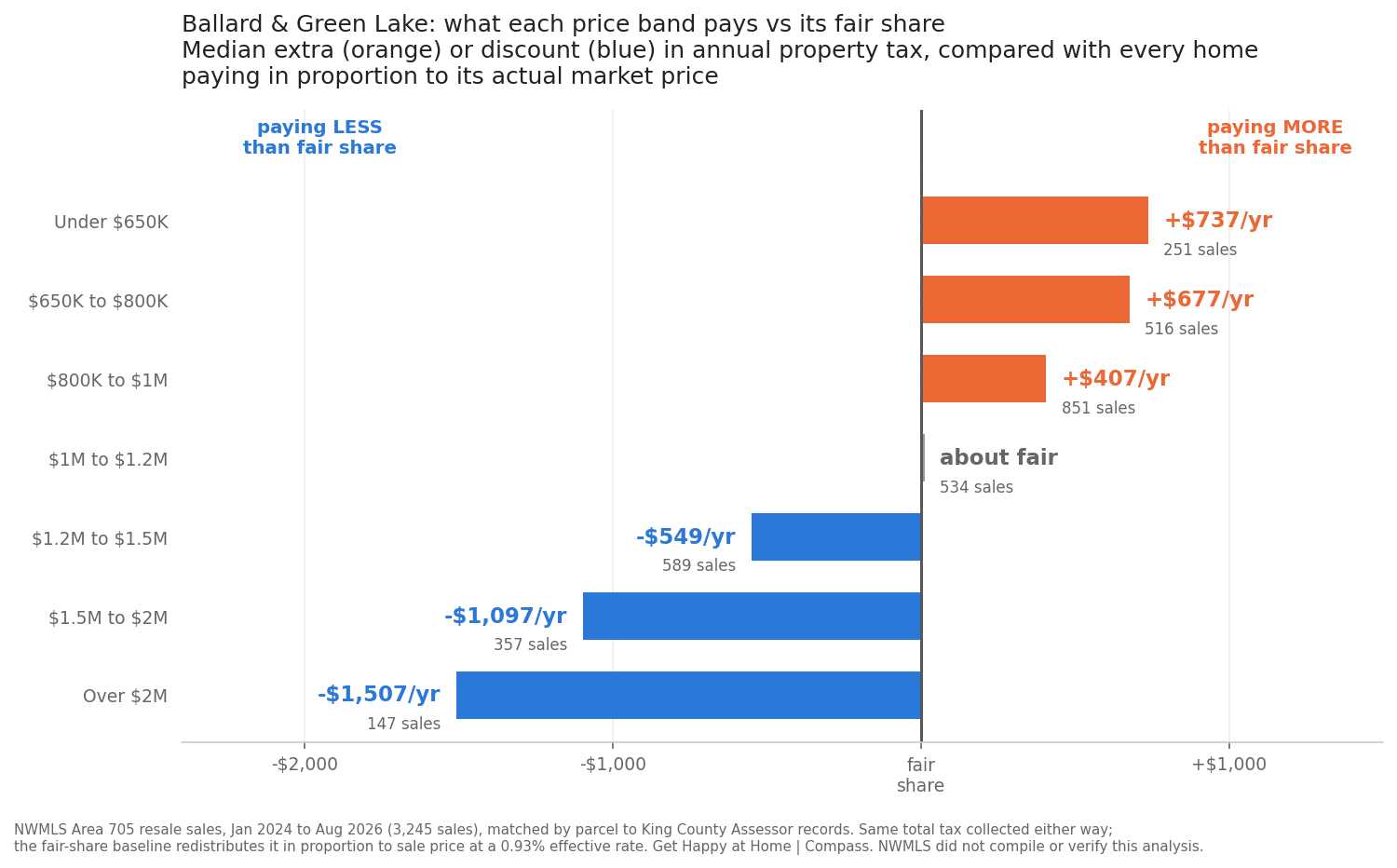
Who pays their fair share in property taxes in the Ballard area, by home value.
The fairest areas are Mercer Island, Bellevue (both sides of 405), East of Lake Sammamish, Redmond, and Kirkland. These are the most expensive markets in the county, and they are the only ones that clear the industry fairness standard.
That pairing is the finding worth sitting with: assessment accuracy is best exactly where homeowners need protection least. If you own in Bellevue, the system values your home with precision. If you own a starter home in Beacon Hill, Ballard, Kent, or Federal Way, the odds are meaningfully higher that you are paying taxes on a number no buyer would pay.
Not because anyone at the county decided they should be. The county values roughly 700,000 parcels with statistical models, and those models can only price what they can see: square footage, lot size, year built, location. They cannot see the things buyers actually pay premiums for, such as renovation quality, condition, layout, and finishes. So the models pull every home toward the neighborhood average. The rough little house gets rounded up. The beautifully remodeled one gets rounded down. In uniform suburban neighborhoods where most houses resemble each other, that averaging works fine, which is why the Eastside scores well. In older urban neighborhoods where a worn 1910 cottage sits next to a taken-to-the-studs remodel, averaging systematically overvalues the modest home and undervalues the premium one.
University of Chicago researchers have documented this same pattern in most counties in America. King County is not an outlier nationally. But within the county, where you live largely determines whether the system is accurate for homes like yours.
Two quick checks:
You file a petition with the King County Board of Equalization, and it costs nothing. The deadline is July 1 or 60 days after your Official Property Value Notice was mailed, whichever is later, so check the date on your notice as soon as it arrives. The evidence that wins is concrete: your own recent arm’s-length purchase price, sales of comparable homes, or documented condition issues the county’s model cannot see. Hearings are typically short and often handled by phone. An appeal cannot raise your home’s market value or hurt your resale price. Assessed value and market value are different numbers, and every buyer’s agent knows it.
One more thing the data says clearly: the homeowners with the strongest statistical case for appealing, owners of entry-level homes in the most biased areas, are historically the least likely to appeal. The correction mechanism only works for the people who use it.
For more detail on the procedure of appealing your King County Tax Assessment, read our blog on the topic (LINK).
Send us your address and your latest valuation notice and we will run your numbers against actual recent sales of comparable homes, no cost and no obligation. If your assessment looks high, we will tell you what evidence to bring to an appeal. If it looks fair, we will tell you that too. Contact us here (LINK).
Does appealing my assessment lower my home’s value when I sell? No. Assessed value and market value are separate numbers. Buyers and appraisers price your home from comparable sales, not from the tax roll.
Will the county raise my assessment because I appealed? The Board of Equalization reviews the evidence about your home’s market value as of the valuation date. Appeals supported by real sales evidence are a normal part of the system, and tens of thousands of King County owners have used it.
Isn’t a high assessment good news about my home’s worth? No. It is only a bill. If the market disagrees with the county’s number, you are paying taxes on value you do not have.
How much could an appeal save? Roughly $9 to $10 per year for every $1,000 of assessed value removed at current Seattle-area rates. A $100,000 reduction saves on the order of $950 per year, every year, until values are next reset.
My home is expensive. Does this data mean I should not appeal? Not at all. These are averages across thousands of sales. Any individual home at any price can be over-assessed, and 10 percent of even the priciest homes sold below their assessed value.
We analyzed roughly 39,000 closed sales of resale residential homes (houses and townhomes, not condos) in King County from January 2024 through August 2026, drawn from Northwest Multiple Listing Service records. Each sale was matched by parcel number to the assessed value in force for that home in its sale year, using the King County Assessor’s public Value History data. New construction, senior exemption properties, floating homes, and extreme outliers were excluded. Bias was measured with the assessment industry’s standard tools, including the IAAO’s price-related bias statistics, within each sale year, and results were tested against alternative explanations including property type, home condition, distressed sales, view premiums, location, and sale timing. Sales from 2023 were analyzed separately because their assessments were set at the January 2022 market peak, a one-time distortion; including them softens the county-wide numbers slightly and changes no neighborhood ranking. Statistics presented here are aggregates; individual listing data is not republished. Sources: Northwest Multiple Listing Service (analysis by Get Happy at Home Group at Compass; NWMLS did not compile or verify this analysis), King County Department of Assessments public data, RCW 84.40.030, Washington Constitution Article VII, IAAO Standard on Ratio Studies, and the University of Chicago Property Tax Fairness project.
Get Happy at Home Group at Compass is a Seattle residential real estate team. We are not tax advisors and this article is for general informational purposes only, not tax or legal advice.