Wa state seller disclosures form blog lead image
Get Educated

Seller Disclosures in Washington State (Form 17): What It Means, How to Read It, and What Buyers Should Watch For

Seller Disclosures in Washington State (Form 17): What It Means, How to Read It, and What Buyers Should Watch For

Almost every Washington homebuyer will see a Form 17 Seller Disclosures at some point. The surprise isn’t that the form exists—it’s how much people misread it.

Quick Answer: What Is Form 17 in Washington State?

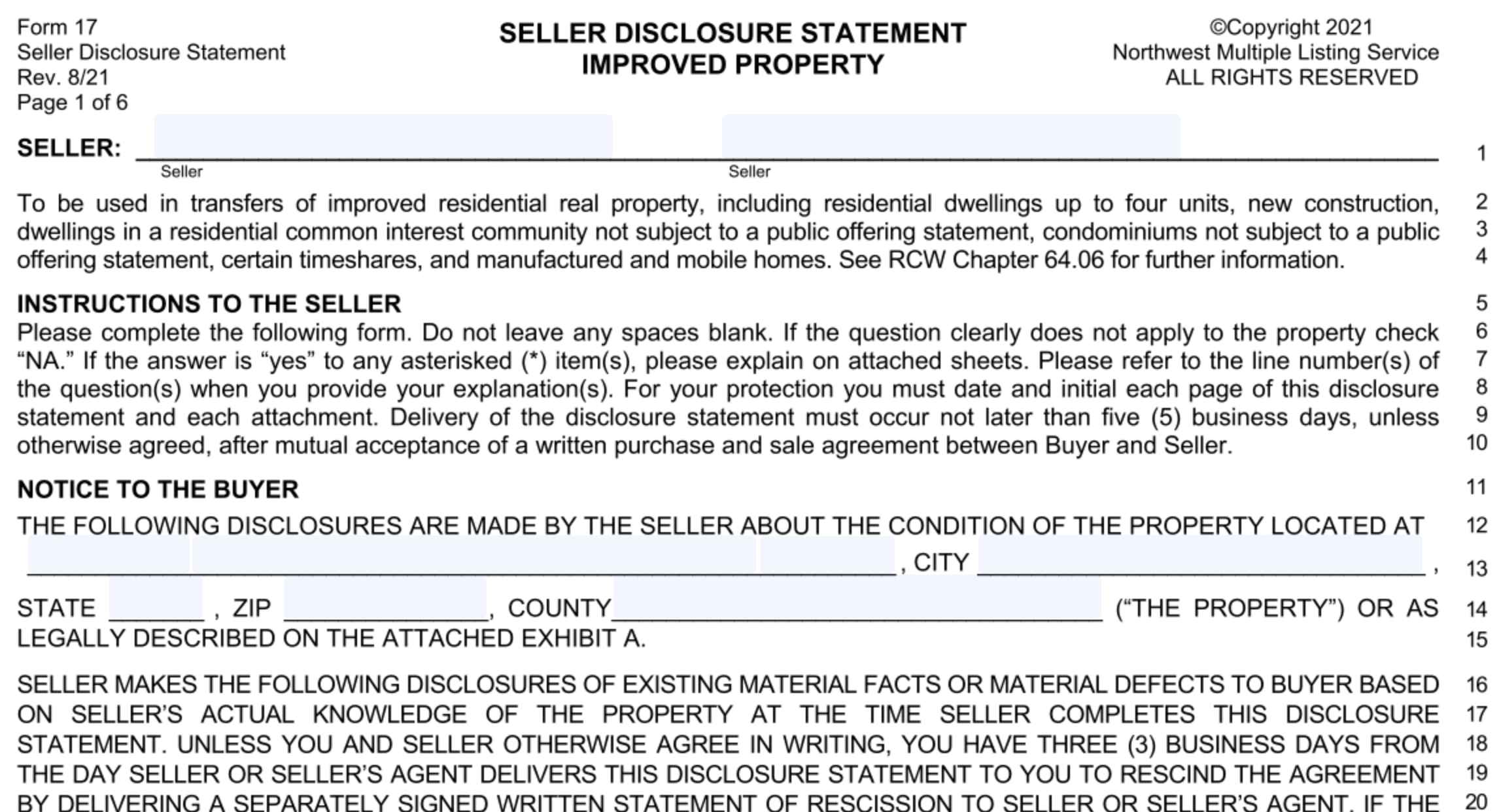
Form 17 is Washington’s standard seller disclosures statement for most improved residential properties (typically 1–4 units). It’s required under RCW 64.06 and asks the seller to disclose known issues with the home—based on the seller’s actual knowledge at the time they sign. It is not a warranty and it does not replace inspections.
  • Who fills it out? Most sellers of 1–4 unit residential homes.
  • What’s in it? Questions about title, systems (water, structural, etc), permits, environmental issues, and HOA matters.
  • Buyer’s right: Three business days to approve or rescind the deal after receiving it (unless waived or timelines are modified in writing).

Quick note: This article is general information for Washington buyers and sellers. It’s not legal advice for your specific situation. If a disclosure issue is headed toward a dispute, talk with your own attorney.

What Exactly Is a Seller Disclosure (Form 17) in Washington?

Washington State Seller Disclosures Form 17 Real estate agent seattle disclosure form

The Washington Seller Disclosure Act, RCW 64.06, requires most sellers to complete and deliver a “Seller Disclosure Statement,” commonly called Form 17. The statute lays out the minimum information the form must include and the exact notice language for buyers.

Form 17 covers the major areas buyers worry about:

  • Ownership, title, and easements
  • Water, sewer, and on-site systems
  • Roof, structure, and drainage
  • Systems (electrical, plumbing, heating, cooling)
  • Alterations and permits
  • Environmental and soil conditions
  • HOA and common-interest issues

For unimproved land and commercial property, Washington uses related but separate disclosures forms. The common thread across all of them is the same: the seller is disclosing existing material facts or material defects based on actual knowledge, not promising the home is perfect.

Lawyer Hat Tip:

Washington is still fundamentally a “buyer beware” state. The seller’s statutory disclosure duty sits alongside that rule—it doesn’t replace the buyer’s duty to do their own due diligence.

Do All Sellers Have to Provide Form 17 in Washington?

No. RCW 64.06.010 lists several exceptions. In plain language, Form 17 does not apply to:

  • Foreclosures and deeds in lieu of foreclosure
  • Gifts or transfers between certain close family members
  • Transfers between spouses or domestic partners in a divorce/dissolution
  • Certain transfers where the buyer already had an ownership interest in the property
  • Some estate, bankruptcy, and court-ordered transfers
  • Certain co-ops and non-fee-simple interests

For most typical buyer/seller transactions involving a house, townhouse, or condo, Form 17 is required unless the buyer has validly waived the right to receive it. Even then, you’ll often see sellers complete it because it helps document what they knew and shared at the time of sale.

Why Does Washington Require Seller Disclosures?

Before Form 17, sellers still had a duty to disclose known “material defects,” but there wasn’t a standard structure or timeline. The Legislature created RCW 64.06 to:

  • Give buyers a better snapshot of the property’s history and known issues
  • Set predictable timelines for disclosure and rescission rights
  • Reduce surprise disputes by getting information out earlier

The key phrase that shows up in the statute and on the form itself is:

“based on seller’s actual knowledge of the property at the time seller completes this disclosure statement.”

“Actual knowledge” means what the seller truly knows—not what they should have known, not what an inspector might have found, and not what a prior owner knew. That’s why guessing is dangerous. If a seller doesn’t know the answer, “Don’t know” is the honest—and legally safer—choice.

How Do You Read Form 17 in Washington Like a Pro?

Most buyers skim Form 17. You’ll get much more out of it if you read it the way a seasoned Seattle agent (or lawyer) does.

1. Start With the “Don’t Know” Column

“Don’t know” is not automatically suspicious. A seller is not required to investigate or research; they only have to answer based on actual knowledge.
That said, clusters of “Don’t know” in certain sections should prompt questions:

  • Water and drainage
  • Roof and structure
  • Alterations and permits
  • Soil, settling, or landslide risk
  • Oil tanks and underground storage

2. Focus on “Yes, with comments”

This is where the real story lives. A few examples:

  • “Roof leak in 2018, repaired by licensed roofer.”
  • “Water in basement during 2021 snowmelt; French drain installed.”
  • “Deck replaced 2020; seller unsure if permit was required.”

These comments point directly to what your inspector and contractor should be paying attention to. When you see water, structure, or unpermitted-work comments, that’s your roadmap.

3. Cross-Check With Other Records

Don’t read Form 17 in isolation. Cross-check it with:

  • Your home inspection and sewer scope
  • City or county permit history (this Seattle building code guide can help you interpret what you’re seeing)
  • HOA resale certificate, budgets, and meeting minutes
  • Any seller-provided bids, receipts, or engineering reports

What Problems Should Buyers Look For on Form 17 in Washington?

The whole form matters, but a few categories are especially important in the Seattle area.

Water Intrusion (Past or Present)

Water is the thing that quietly does the most damage to Seattle area homes. Look for:

  • Basement or crawlspace moisture
  • Past flooding or “water events”
  • Evidence of French drains, sump pumps, or drainage systems

If the home has a basement, pair the disclosure with a careful inspection and, ideally, a moisture meter. You can also compare what you see with our Seattle basement flooding guide.

Unpermitted Work and Finished Basements

Seattle is full of finished basements and bonus rooms that were never permitted or never brought fully up to code. Pay extra attention when the seller discloses:

  • Basement remodels that “may not have permits”
  • Bedrooms with questionable egress windows
  • Extra kitchens or wet bars added after original construction

A basement “bedroom” without legal egress might work for your lifestyle, but it doesn’t function as a legal bedroom in appraisal or future resale. The critical question is not just “Is it nice?” but “Is it safe and legal?”

Foundation, Soil, and Settling

In Seattle’s glacial soils, some small cracks and cosmetic settling are normal. What you’re watching for is:

  • Doors and windows that no longer operate properly
  • Past structural repairs or monitoring
  • Disclosures about retaining walls or sloped lots

Oil Tanks and Underground Storage

Older Seattle neighborhoods often have underground heating oil tanks. If the seller mentions:

  • “Abandoned oil tank filled with sand”
  • “Converted from oil to gas”
  • “Past oil use, unsure about tank”

That’s a cue to investigate possible contamination and whether a formal decommissioning was done.

HOA Assessments and Building Work

For condos and townhouses, Form 17 should flag:

  • Known or pending special assessments
  • Major exterior projects (siding, windows, roofs)
  • Litigation involving the HOA or building

If you see “assessment expected” or “building under assessment,” pair that with the HOA documents and this condo-under-assessment guide.

What Does “Don’t Know” Really Mean on Form 17?

“Don’t know” is built into the statute for a reason. Sellers are not required to investigate or open walls. Common, benign “Don’t know” answers include:

  • Exact age of wiring or plumbing in older homes
  • Type of insulation in inaccessible areas
  • Details about work done before they owned the property

Use more caution when “Don’t know” shows up for:

  • Water intrusion, roof leaks, or drainage problems
  • Structural movement or settlement
  • Whether major alterations were permitted
  • Oil tanks, septic systems, or shared wells

In those categories, “Don’t know” is a starting point, not the end of the conversation.

What Can Go Wrong With Seller Disclosures? 10 Realistic Gray-Area Scenarios

Most Form 17 disputes don’t involve an outright lie. They live in the gray areas where memory, assumptions, and actual knowledge collide. Here are ten
scenarios that come up again and again:

  1. “We fixed it but didn’t document it.”
    The seller discloses a past leak or crack and says it was repaired, but there’s no invoice or engineer’s letter. The work might be excellent—or might not.
    Buyers should evaluate the current condition, not the seller’s memory of the fix.
  2. “It only leaks in extreme weather.”
    If the seller has experienced water intrusion during big snowmelt events or heavy storms, that history belongs on Form 17, even if it seems infrequent.
  3. “We painted over the stain.”
    Cosmetic repairs don’t erase the duty to disclose the underlying issue. A fresh coat of paint on a ceiling that once leaked is not a substitute for an honest answer.
  4. “We think it’s fine because it hasn’t happened in years.”
    A seller who knows about past flooding, settling, or structural work is expected to disclose that history, even if the issue hasn’t recurred recently.
  5. Past settling in glacial soils.
    Many Seattle homes show some movement. “We had minor settling; engineer said it was normal and needed no repair” is a very different disclosure from, “We installed helical piers to stabilize the foundation.”
  6. Unpermitted basement bedrooms.
    A seller markets three “bedrooms,” but one is a basement room without proper egress. If the seller knows the room doesn’t meet bedroom standards, that’s a disclosure issue—not just a marketing one.
  7. “We never used the fireplace.”
    If the seller truly never used it, “Don’t know” is the right answer regarding functionality. Guessing “Yes, it works” because it looks fine is how misrepresentation happens.
  8. “The HOA mentioned a study but nothing was official.”
    If the seller has attended meetings where future assessments or major projects were discussed, that’s usually material—even if final numbers aren’t set.
  9. “The oil tank was filled with sand years ago.”
    If the seller knows about a past oil tank, its existence and any “abandonment” belong on the form. Whether a modern decommissioning was done is a separate, important question.
  10. “We assumed the contractor pulled the permits.”
    A seller who never verified permits should not answer “Yes, fully permitted” based on assumption. “Don’t know; contractor handled it” is more accurate and safer.

Lawyer Hat Tip:

For liability, what matters is what the seller actually knew and what they wrote down—not what they wish they had said in hindsight. Guessing “No” when the truthful answer is “Don’t know” is one of the most common mistakes.

How Can Buyers Protect Themselves When Reviewing Form 17?

  • Treat Form 17 as a roadmap, not a verdict. Use it to target inspections and questions.
  • Always inspect. Especially basements, roofs, drainage, and sewer lines.
  • Check permit history. This is crucial for additions, basement remodels, and garage conversions.
  • Match disclosures to what you see. If the form is “clean” but you see suspicious repairs, stains, or patched areas, ask why.
  • Ask follow-up questions early. Right after mutual acceptance, not the week of closing.

3-Minute Buyer Checklist for Form 17

  • Scan water, roof, and foundation sections for any “Yes” answers.
  • Highlight anything about basements, drainage, or past moisture.
  • Flag references to unpermitted work or “not sure about permits.”
  • Note any HOA assessments or litigation.
  • Write down every item that deserves an inspection or follow-up question.

How Should Sellers Fill Out Form 17 to Stay Compliant?

Form 17 is not a test you “pass” by saying as little as possible. It’s your chance to show that you’ve been straightforward.

  • Answer based on facts. If you know it, say it. If you don’t, say “Don’t know.”
  • Don’t guess. Guesses are where misrepresentation claims begin.
  • Use the comments box. A short explanation (“Leak in 2018, repaired; no issues since”) is often reassuring to buyers.
  • Gather your paperwork. Bids, receipts, engineering letters, and permit records all support your answers.
  • Be candid about big repairs. Many buyers prefer a home with known, fixed issues over a home with unknown ones.

Rescission Rules in Washington: Exact Timing and When Form 17 Lets Buyers Walk Away

Under RCW 64.06.030, the timing works like this:

  1. Seller delivers Form 17.
    Unless you agree otherwise in writing, the seller has five business days after mutual acceptance to deliver a completed Form 17.
  2. Buyer’s three-business-day window.
    From receipt of the form, the buyer has three business days to either:

    • approve and accept the disclosure; or
    • rescind the purchase agreement for any reason or no reason at all.

    If you receive Form 17 before mutual acceptance, that three-business-day period generally runs from mutual acceptance instead of from the day you first saw the form.

  3. Rescission must be in writing.
    The buyer must deliver written notice of rescission within that three-business-day window. If they do, the agreement is void and earnest money is returned (subject to any agreed disbursements).
  4. Silence = acceptance.
    If the buyer doesn’t deliver written rescission on time, Form 17 is deemed approved.

Do Amendments Restart the Three-Day Clock?

When a seller materially amends Form 17—say, to disclose a newly discovered defect—buyers often regain a three-business-day rescission period starting from receipt of the amended disclosure. RCW 64.06.040 addresses the seller’s duty to correct and how amendments affect rights. Practically speaking:

  • If it’s serious enough that a typical buyer might rethink the purchase, treat it as material.
  • If you’re the buyer, assume you need to act quickly if an amendment worries you.

When Rescission Does Not Apply

The three-day rescission right generally does not apply when:

  • The transaction is exempt from Form 17 (for example, certain estate or foreclosure transfers).
  • The buyer has signed a valid waiver of the right to receive the disclosure statement.
  • The buyer’s rescission deadline has already passed and no material amendment has been made.
  • The sale has already closed.

Lawyer Hat Tip:

Rescission rights are brutally deadline-driven. If you’re thinking about backing out based on Form 17, don’t wait to “sleep on it” for a week. Count business days and get advice quickly.

When Should You Bring in an Attorney or Specialist?

It’s time to talk with an attorney (and often an inspector or engineer) when:

  • You have evidence the seller knew something significant and did not disclose it.
  • You discover unpermitted structural work that wasn’t mentioned on Form 17.
  • A major issue surfaces after closing that appears inconsistent with the disclosure.
  • There’s a dispute about whether you’re still within your rescission period.

You don’t need a lawyer to interpret every “Yes” or “Don’t know,” but you do want one when a six-figure problem is on the line.

FAQs About Seller Disclosures (Form 17) in Washington

Is Form 17 required for condos?

Yes. Most condo sales use a condo-specific version of the disclosure (often labeled Form 17C), plus the separate HOA resale and assessment documents.

Do new-construction builders have to provide Form 17?

Not always. Many new-construction sales fall into exemption categories. You’ll often see builders use their own addenda and warranties instead, even though buyers should still perform inspections and due diligence.

Can a buyer walk away after reading Form 17?

Yes. If Form 17 is required and not waived, buyers generally have three business days from receipt of the fully completed statement (or from mutual acceptance, if it was delivered earlier) to rescind in writing.

Is a seller responsible for issues they genuinely didn’t know about?

Washington’s standard is actual knowledge. A seller is typically liable for knowingly false statements about material issues—not for hidden defects they truly didn’t know were there.

What if the seller lies on Form 17?

Intentional misrepresentation or concealment of a material defect can support legal claims. If you believe that’s happened, save all documentation and talk with an attorney before taking your next step.

Bottom Line: Form 17 Is Powerful, but It’s Not the Whole Story

Form 17 is one of the best tools you have for understanding a home’s history—but it’s still only one piece of the puzzle. It tells you what the seller knows and is willing to put in writing. Your inspection, permit research, and HOA review tell the rest.

If you’d like a second set of eyes on a Form 17—whether you’re buying or getting ready to sell—I’m happy to walk through it with both my real estate hat and my lawyer hat on, and help you decide what deserves a closer look.


Ryan Palardy, Seattle real estate agent, realtor, and licensed attorney at Get Happy at Home, Compass Washington. Buyer and seller representative expert.About the Author: Ryan Palardy

Ryan Palardy is a Real Estate Broker & Attorney who helps buyers and sellers move through Seattle’s housing market with strategy, confidence, and a clear understanding of what truly drives value. As part of the Get Happy at Home team, he brings the weight of more than 25 years of combined experience, $600 million in closed sales, and the trust of 1,300+ clients across Seattle and the Eastside.

Ryan’s work centers on first-time buyers, out-of-area relocations, tech employees, and homeowners preparing for a pre-sale remodel. He and the Get Happy at Home team were named Best Real Estate Team in the Seattle Times “Best in the Pacific Northwest” awards for 2025, and are known for consistently delivering top-of-market results for their sellers. The team has earned hundreds of five-star reviews across every major platform—reflecting a long-standing commitment to candor, preparation, and client advocacy.

Before real estate, Ryan practiced law in Washington after earning his J.D. from the University of Washington and receiving his WSBA license in 2018. That background shows up in the way he structures deals, spots risks early, and protects his clients’ interests. Ryan lives in Northwest Seattle with his family.

If you’re exploring a move, planning ahead, or want a clearer read on your options, you can reach Ryan directly—or connect on LinkedIn for ongoing Seattle market insights.

License info: Licensed Real Estate Broker in WA, License #21024995. Office: Seattle, WA.

Want to know more?

CHAT WITH US

Ryan Palardy