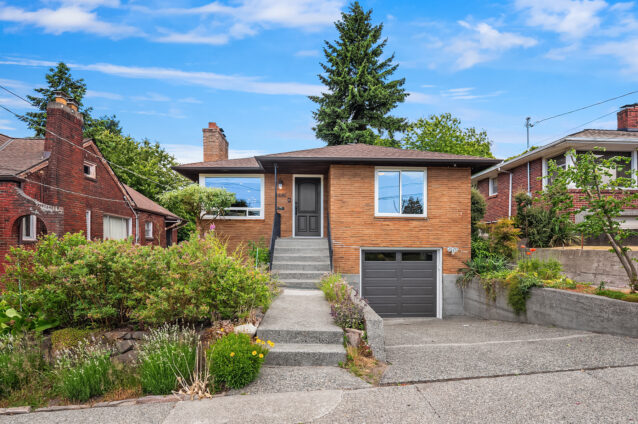
Why Now Is the Right Time to Buy a Smaller Home in Ballard
- Ryan Palardy,
- May 8, 2026



Published May 8, 2026 by Ryan Palardy, JD, Partner at Get Happy at Home (Compass) Filed under: Ballard real estate, Greenlake real estate, North Seattle market analysis, Buyer strategy
Are you thinking about buying a home in Ballard? Smaller homes (less than 2,000 square feet) are the best buy in Ballard right now. On average, buyers in this segment face less competition, are not paying any premium over list price, and have the most inventory to choose from in years. The 2,001 to 2,500 square foot bracket is, by contrast, the worst place to be a buyer in Ballard today; homes in that bracket are selling for an average of 107.2% of original list price and getting 4-8 showings per day in the first week on market.

Smaller. Specifically, homes 2,000 square feet or less. As of April 2026, the smaller-home segment in Ballard / Greenlake (NWMLS Area 705) is the only segment where buyers are not paying over list, where new listings are running 30% to 40% above the five-year average, and where prices are actually below 2025 levels. The 2,000 square foot plus bracket remains a hot seller’s market and is the worst spot for a buyer right now.
Competition. Sellers love it, but for buyers, competition is your worst enemy. It drives prices up, limits your options, and forces you to increase your risk tolerance when writing offers.
If you think buying in Ballard is a non-starter for you, take a step back and consider the facts on the ground. Buying a home may be impossible IF what you want is the same 2000 plus square foot, 3-4 bed, 2+ bath house everyone else is competing for. However, if you’re willing to compromise on size, you might be pleasantly surprised by your options. And, if history tells us anything, the homes that are cheaper now tend to catch up in appreciation over the coming years. Meaning the small(er) home you buy now has a real chance of out-appreciating the big(ger) homes your friends are sweating over.
We pulled five metrics from the Northwest Multiple Listing Service via InfoSparks for Area 705, on a rolling 3-month basis: average sales price, median sales price, new listings, average percent of original price, and showings per listing. Here is the April 2026 snapshot, by size bracket.
| Size bracket | Showings / listing | Sale-to-list ratio | New listings (3-mo) | Avg sale price | Median sale price |
|---|---|---|---|---|---|
| 1,500 sf or less | 7.1 | 100.0% | 210 | $739,769 | $720,000 |
| 1,501 to 2,000 sf | 9.9 | 103.3% | 141 | $989,607 | $985,000 |
| 2,001 to 2,500 sf | 12.8 | 107.2% | 112 | $1,285,160 | $1,278,000 |
| 2,501 sf or more | 10.4 | 103.5% | 118 | $1,617,061 | $1,505,000 |
One question we know readers will ask: is this just a townhouse story? It is not. We re-ran the same analysis with townhouses pulled out of the data set, and the pattern holds. Smaller, single-family homes in Ballard show the same buyer-leverage advantage you see in the table above.
Three things jump off this table.
Showings per listing is the cleanest demand metric we track. In April 2026, sub-1,500 square foot homes saw 7.1 showings per listing. The 2,001 to 2,500 segment saw 12.8. That means a buyer touring a 1,400 square foot Loyal Heights or Crown Hill bungalow is competing with roughly half as many shoppers as a buyer touring a 2,300 square foot home a few blocks away in Phinney Ridge or Whittier Heights.
The drop is not just relative; it is also extreme by the segment’s own history. Sub-1,500 square foot showings are down 37% from the five-year average of 11.3 showings per listing. The 2,001 to 2,500 segment is only down 20% from its five-year average. Translation: the smaller bracket is cooling much faster than the mid-large bracket.
Average percent of original list price in April 2026 was a flat 100.0% for sub-1,500 square foot homes. The 2,001 to 2,500 segment was 107.2%. On the average $1.28 million sale in that bracket, that is roughly $92,000 over original ask, paid by the buyer.
For perspective, in April 2022 the 2,001 to 2,500 bracket peaked at 121.2% of original price. The current 107.2% is well off that peak but still firmly in seller’s-market territory. The sub-1,500 bracket, at 100.0%, is not.
There were 210 new listings in the sub-1,500 square foot bracket on a three-month rolling basis in April 2026. That is 43.5% above the five-year average of 146. The 1,501 to 2,000 bracket also has more selection than usual (141 listings, 12% above its five-year norm).
More inventory means the buyer can wait for the right block, the right floor plan, the right inspection report. That ability to walk away from the wrong house is itself a form of buyer leverage that simply did not exist until recently.
Yes. Year-over-year average price changes for April 2026 versus April 2025:
Three of four segments are cheaper than a year ago. Only the mid-size bracket is appreciating, and that appreciation is being driven by exactly the bidding-war dynamics described above. If the goal is to enter at a lower price than a year ago and avoid the multi-offer scrum, smaller is the only segment that delivers both.
This is where the case for smaller homes goes from “right now” to “right now and into the next two to three years.”
We analyzed every monthly observation of year-over-year average price-per-square-foot appreciation for Seattle residential sales from January 2006 through April 2026, by the same four size brackets. Three findings:
Leadership does not persist. Across 220 monthly observations, the size bracket leading on YoY appreciation in any given month had only a 19.5% chance of still being the leader 12 months later. Pure random rotation among four brackets would produce 25%. The market actively rotates leadership, slightly faster than random.
The leader’s outperformance gap collapses fast. Pooled across every leadership month, the leader’s outperformance versus the average of the other three brackets fell from +4.65 percentage points when leading to negative 1.00 percentage points twelve months later. By 24 months later, the gap was essentially zero.
Long-run cumulative growth is roughly equal across sizes. From January 2006 to April 2026, all four size brackets grew between 2.15x and 2.60x. They cross each other repeatedly. There is no structural premium to any particular size; there are only cyclical phases when one or another runs hot.
The implication for Ballard buyers today: the segment currently leading on price appreciation (2,001 to 2,500 square feet) is the segment historically most likely to underperform over the next 12 to 24 months. The segments lagging on price (sub-1,500 and 1,501 to 2,000 square feet) are historically positioned to outperform on a 24 to 36 month horizon. That is mean reversion, and it is the dominant pattern in the data.
We should always steelman the other side. Here is the strongest case for going bigger right now in Ballard:
“Larger homes have crashed harder. Aren’t they the value play?” The 2,501 square foot and larger bracket is down 10.1% year-over-year, the steepest drop of any segment. That looks like a discount. The problem is that showings per listing in that bracket actually went up year-over-year (9.4 to 10.4) while every other bracket fell. Demand is rising into the price drop, and the sale-to-list ratio is still 103.5%. That is not a buyer’s market; that is a market where prices reset and demand is already returning. The window may close fast.
“Bigger homes are a better long-run inflation hedge.” The 20-year data do not support this. The four brackets grew within a tight band of each other. Bigger is not structurally better; it just gets paid more during euphoric phases of the cycle, and we are not currently in one of those phases.
“What if my family genuinely needs the space?” This is the only argument that beats the data. If you need four bedrooms within 12 months because of a baby or a parent moving in, buy what you need. The advice in this post is for buyers who have flexibility on size and are weighing the trade-off purely on market dynamics.
This advice fits cleanly for:
This advice does not fit:
We watch the Ballard data weekly at our Tuesday listing meeting. The signals that would tell us the smaller-home window is closing:
If two or more of those flip at the same time, the trade is over. As of May 8, 2026, none of them have.
Yes. As of April 2026, sub-1,500 square foot homes in Ballard are selling at exactly 100.0% of original list price with 7.1 showings per listing, both meaningfully better for buyers than any other size segment. New listings in this bracket are 43.5% above the five-year average, giving buyers more selection than usual.
It depends on the size of the home. As of April 2026, average sale prices in Ballard are down 6.2% year-over-year for homes 1,500 square feet or smaller, down 6.0% for 1,501 to 2,000 square feet, up 4.7% for 2,001 to 2,500 square feet, and down 10.1% for 2,501 square feet or larger. Three of four segments are cheaper than a year ago.
In April 2026, the average percent of original price across Ballard / Greenlake was 100.0% for homes 1,500 square feet or less, 103.3% for 1,501 to 2,000 square feet, 107.2% for 2,001 to 2,500 square feet, and 103.5% for 2,501 square feet or larger. Only the smallest segment is selling without a buyer premium over original list.
The historical Seattle data suggest the segments currently lagging on price (smaller homes) are positioned to outperform on a two to three year horizon. Waiting introduces interest-rate and competition risk. The current setup, where prices are off year-ago levels and showings per listing are well below five-year averages, is unusual and historically does not last more than a few quarters once mortgage rates ease.
Over the last 20 years (January 2006 to April 2026), all four NWMLS size brackets in Seattle grew between 2.15x and 2.60x in average price per square foot. There is no structural appreciation premium to any one size. Leadership rotates among brackets and tends to mean-revert within 12 to 24 months.
All Ballard / Greenlake figures in this post come from the Northwest Multiple Listing Service. Reach out; we will happily share the data with you.
Data source. Northwest Multiple Listing Service (NWMLS), accessed via InfoSparks by ShowingTime, pulled May 8, 2026. All figures are 3-month rolling and use the “Previously Owned, Residential” filter for NWMLS Area 705 (Ballard / Greenlake). The 20-year Seattle-wide context is the same source for the broader Seattle residential market.
Size brackets. NWMLS reports by four square-footage brackets: 1,500 or less, 1,501 to 2,000, 2,001 to 2,500, and 2,501 or more. We use those brackets unchanged.
Year-over-year measurement. Computed as (April 2026 value / April 2025 value) minus 1, expressed as a percentage. Every figure in this post was verified against the raw CSV before publication.
Leadership analysis. Defined as the size bracket with the highest year-over-year change in average price per square foot in any given month. Persistence and mean-reversion statistics are computed across all 220 monthly observations from April 2007 through April 2026.
Townhouse robustness check. We re-ran the size-bracket analysis with townhouses excluded and the smaller-home advantage in Ballard holds. The pattern is not driven by townhouse inventory.
What this analysis does not control for. Composition shifts within a bracket (a 2,001 square foot home and a 2,499 square foot home are in the same bucket), neighborhood mix within Area 705, condition, year built, and views. Buyers should treat the bracket-level signal as a starting framework, not a substitute for a property-by-property analysis.
I have been showing homes in Ballard, Phinney Ridge, Greenlake, Loyal Heights, Crown Hill, Sunset Hill, and Greenwood for years now, and one of the lessons that keeps coming back is that the right answer in real estate almost always depends on what segment of the market you are actually in. The neighborhood story can be one thing while the size-bracket story is another. April 2026 is one of those moments where the size-bracket story dominates.
If you are already in conversation with us, expect to hear me bring this up. If you are not, and you are weighing a Ballard purchase this spring, I would love to walk you through the specific homes that fit your budget and our read on whether each one prices to the data above.
Ryan Palardy, JD Partner, Get Happy at Home (Compass) ryan@gethappyathome.com | 774.266.3842 gethappyathome.com