
10 Seattle Neighborhoods, 10 Things Even Locals Don’t Know
- Sheyenne Lester,
- August 7, 2026



We call it Neighborhood Dating. It’s what we do with buyers before they fall for a house: we drive them around, we tell them what a block actually feels like on a Tuesday, and somewhere in there we usually end up telling a story that has nothing to do with square footage. Turns out those stories are the good part. So we went digging, past the walk scores and the median prices, into the actual history of ten Seattle neighborhoods. Some of it is verified fact. Some of it is local legend that turned out to be false, which is honestly the better story. Here’s what we found.

Ballard was its own incorporated city from 1890 to 1907, and for a minute it was doing fine on its own. By 1900 it had over 4,500 residents, making it the seventh largest city in the entire state. Then its water supply started failing, and in November 1906 residents voted, barely, 996 to 874, to annex into Seattle. When the merger became official on May 29, 1907, Ballard’s City Hall was draped in black crepe and its flag flown at half mast. That’s not a metaphor. People genuinely mourned the loss of their city that day.
You’ll hear the annexation blamed on a dead horse found in the reservoir. It’s a great story. It’s also not true: local historians looked into it and found no record of it ever happening, just decades of repetition.
What is true is “Free Ballard.” In 2002, the Ballard Chamber of Commerce, with an assist from the owner of novelty shop Archie McPhee, coined the slogan as a tongue-in-cheek jab at feeling ignored by Seattle City Hall. For the 2007 centennial of annexation, to the day, Ballard threw itself a mock-mourning party: black armbands, T-shirts reading “Free Ballard: 100 Years of Seattle Tyranny,” and residents ringing the original 1899 City Hall bell, still preserved on Ballard Avenue. Those bumper stickers are still around. Nobody’s actually trying to secede. They just haven’t fully forgiven Seattle either. If you’re curious what the neighborhood looks like today, we wrote up the current Ballard market here.

White Center isn’t part of Seattle. It’s unincorporated King County, patrolled by the Sheriff, not SPD, and it’s been proving for over a century that it doesn’t need anyone’s permission to take care of itself. In 1922, when Seattle City Light was legally blocked from extending service outside city limits, White Center residents took the day off, dug their own post holes, and strung their own electrical wire themselves, then called the city for a hookup before the injunction could stop them.
That same self-reliant streak is showing up in its newest chapter. The Lumber Yard Bar opened in 2017 as White Center’s first LGBTQ+ bar, and it kicked off a real shift: more queer-friendly bars followed, a historic 1937 roller rink started hosting Pride Skate nights, and the neighborhood now runs its own volunteer-organized Pride Street Festival, drawing well over a hundred vendors each year. It hasn’t been easy. In 2021, an arson fire investigated as a hate crime tore through the Lumber Yard Bar and several neighboring businesses. The bar rebuilt and reopened. The Pride festival kept going.
It fits a neighborhood that’s always shrugged off outside labels anyway. A well-known local bumper sticker sums it up better than we could: “White Center: Not quite centered and not quite White.”

The first non-Native settlers in Seattle didn’t land downtown. In November 1851, the Denny Party came ashore at Alki Point in the rain and tried to build a town they optimistically named New York. It went badly enough, fast enough, that most of them abandoned it for the better harbor across Elliott Bay by spring, which is now downtown Seattle. The name that stuck, Alki, is Chinook trade jargon for “by and by,” or “someday.” It was basically a joke about their own failed ambitions that outlived the joke.
West Seattle later became its own incorporated city in 1902, building the first municipally owned streetcar system in the entire country before voting to join Seattle in 1907. It’s tried to leave more than once since. Secession pushes surfaced in 1978, the 1980s, and the 1990s, usually tied to bridge access and city planning frustrations. In 1995, the state legislature actually passed a bill to let West Seattle secede. The governor vetoed it.
The bridge itself has its own saga. The current high bridge only got built because a freighter rammed the old low bridge in 1978, forcing the issue after decades of delay. Then in 2020, SDOT abruptly closed that same high bridge after inspectors found the cracks had grown two feet in two weeks, a first-ever civil emergency declaration over an infrastructure closure. It stayed shut two and a half years.
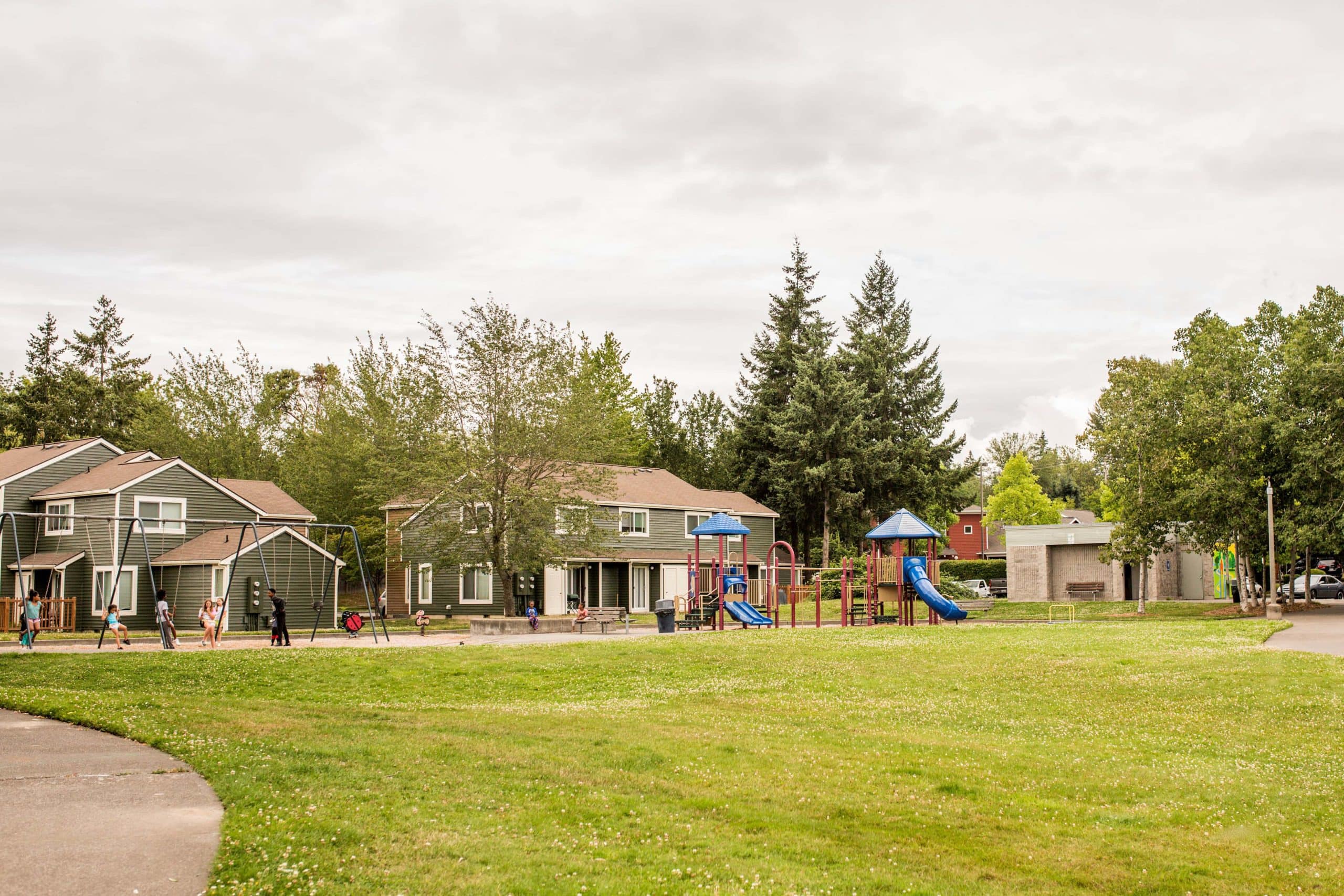
Bryant doesn’t have a HistoryLink thumbnail essay the way most Seattle neighborhoods do. It’s genuinely one of the city’s lowest-profile pockets, tucked between Ravenna and View Ridge, and it stayed that way almost by design.
It’s also named backwards from nearly every other northeast Seattle neighborhood. Wedgwood, Laurelhurst, and View Ridge all lent their names to the local school. Bryant did the opposite: the neighborhood took its name from Bryant Elementary, which was named for 19th-century American poet William Cullen Bryant, a man with no actual connection to Seattle whatsoever. The name didn’t even catch on locally until the 1920s. Before that, the area was just called Yesler or Ravenna.
The neighborhood association didn’t formally claim a boundary for it until 2012. Before that, this stretch between 35th and 40th Ave NE was a literal unclaimed pocket wedged between three other neighborhood associations’ territory, a donut hole nobody had officially adopted. One moving-company guide describes it best: so quiet it barely registers on the radar for most locals. We’d argue that’s exactly the appeal. Here’s our own take on the neighborhood, if you want more.

Madrona’s motto is The Peaceable Kingdom, and for most of the 20th century it earned it, becoming one of the few Seattle neighborhoods where Black, Chinese, and Jewish families could buy homes while redlining and racial covenants locked them out of nearly everywhere else. But peace had a boundary. An unwritten agreement among realtors reportedly kept homes east of 34th Avenue, up toward the lake, off-limits to Black buyers for decades. The color line wasn’t citywide. It ran through the middle of one neighborhood.
Madrona was also home base for Washington’s first Black Panther Party chapter in the late 1960s, with members drilling in formation right on Madrona Playfield. And between 1968 and 1970, the neighborhood saw a wave of racially charged bombings, including one at a state legislator’s home while his five children were inside, that pushed two sitting lawmakers out of politics entirely.
Before any of that, Madrona Park started as a private lakeside resort in the 1890s, complete with a Japanese tea house and a private trolley line, built purely to lure homebuyers down to see the beach.

Green Lake is a kettle lake, a chunk of glacial ice that got buried and melted in place roughly 50,000 years ago. Sediment pulled from the bottom has even turned up volcanic ash from an eruption 6,700 years ago. The name itself may be an accident of timing: a surveyor logged it in September 1855, during what was likely a seasonal algae bloom, and the name just stuck.
The lake you see today isn’t the original. Around 1910, the city deliberately lowered it six to seven feet to create more park land, which permanently dried up its natural outlet, Ravenna Creek. Algae kept being a problem for decades after, so bad that the city seriously considered converting the lake to salt water or draining it entirely to scrape out the muck.
For a stretch mid-century, the lake also had a 5,600-seat outdoor amphitheater called the Aqua Theater, built in just 67 days in 1950. It hosted Broadway-style musicals, Bob Hope, and, near the end of its run, the Grateful Dead and Led Zeppelin. It was mostly torn down in 1979, though on a clear winter day, locals say you can still see the old canvas pool cover sitting on the lake bottom.

Guy Phinney was a Nova Scotia businessman who bought 200 acres above Green Lake in 1889 and built himself an English-style manor with a private deer park, a rose garden, and his own private streetcar line, built specifically to lure prospective homebuyers out to see the estate. After Phinney died in 1893, his widow couldn’t maintain it and sold it to the city in 1899. The mayor actually vetoed the purchase as too expensive; the City Council overrode him anyway. That estate became Woodland Park Zoo.
Decades later, Woodland Park Zoo quietly changed how zoos work everywhere. Starting in the mid-1970s, its design team pioneered “landscape immersion,” the now-standard idea of hiding cages and barriers so visitors feel like they’re inside the animal’s actual habitat instead of looking at a cage. It debuted with the zoo’s 1978 gorilla exhibit and has been copied by zoos worldwide ever since.
Nobody, to this day, can fully agree on where Phinney Ridge stops and Greenwood starts. It’s a genuinely disputed, unofficial boundary, which is how the local business district ended up informally branding itself “PhinneyWood” rather than pick a side.

Columbia City started in 1891 as a straightforward real estate play. A promoter built an electric railway seven miles south from downtown specifically to open up the forest for development, then sold the first lots from a canvas tent under the slogan “Columbia, Watch It Grow!” It incorporated as its own independent town in 1893 and stayed proudly dry: no saloon was ever allowed within its limits, and voters rejected annexation to Seattle for years specifically to protect that local control before finally joining in 1907.
Here’s the part almost everyone gets wrong. You’ve probably heard that zip code 98118, which includes Columbia City, is the most diverse zip code in America. It isn’t, and it never was. The claim traces back to a couple of 2010 news reports that got repeated so often even a U.S. Senator cited it at naturalization ceremonies. The Census Bureau itself says it never made any such ranking, calling it close to an urban myth. A real analysis using an actual diversity index puts 98118 third most diverse in Washington state and 64th nationally. Still genuinely one of the most diverse pockets in the country, just not the record holder the internet keeps insisting it is.
What is real: waves of Italian, Japanese, and Filipino immigrants, a Samoan community that formed after the Navy relocated families from Pago Pago in 1951, and later Vietnamese and East African communities, all layered into a few square blocks now anchored by a landmarked 1915 Carnegie library and a business, Hitt Fireworks, founded on the neighborhood’s hillside in 1905 that’s credited with contributing pyrotechnic effects to Gone with the Wind.

In the mid-1970s, civil rights advocates painted an actual red line down 14th Avenue, from Yesler Way to Union Street, as a literal protest against redlining, the practice of denying loans based on race. It wasn’t metaphorical. The Central District had become one of the only neighborhoods in Seattle where Black families were allowed to buy homes at all, and by 1970 it was as much as 90% Black in some tracts. Because decades of denied loans meant those families built little equity, when property values rose decades later, most couldn’t afford to stay. The same tracts are now under 15% Black.
Before the displacement, the neighborhood built something remarkable. Jackson Street was Seattle’s answer to Harlem, home to 34 nightclubs at its peak in the 1930s and 40s. A teenage Ray Charles, fresh off a bus from Florida, recorded Seattle’s first R&B record there. Quincy Jones and Ernestine Anderson came up on the same strip. Washington Hall hosted W.E.B. Du Bois, Duke Ellington, and Billie Holiday, and in 1960 it hosted a teenage Jimi Hendrix’s first band, not long before he was expelled from Garfield High. His actual childhood home, on South Washington Street, was later moved to Renton and torn down when restoration funding fell through; a small park near the original site is named for him today.

The building at 2524 16th Ave S started as Beacon Hill School, built in 1909. By the early 1970s it had been shuttered and boarded up, another empty building on the hill, until a defunded adult-education program left a group of laid-off Chicano and Latino faculty and staff without a place to work and without much patience left for asking permission. On October 11, 1972, led by Roberto Maestas, they walked into the vacant school and didn’t leave.
It was not a symbolic gesture. The building had no heat and no running water, and that winter turned out to be a record cold one. The occupiers stayed anyway, month after month, while also showing up at Seattle City Council chambers and the mayor’s office to press their case; some were arrested along the way. Three months in, the city gave in and agreed to lease them the building for a dollar a year. That occupation became El Centro de la Raza, and the name stuck to the building along with the organization.
The story didn’t end there. In 1997, the school district raised the rent to fair market value, about $12,000 a month, and within two years El Centro owed $150,000 in back rent it had no way to pay. It took another round of organizing, this time in city hall and Olympia rather than an empty hallway, to secure roughly a million dollars in city and state grants that let El Centro buy the building outright. What started as a three-month occupation of an abandoned school turned into permanent, owned ground on Beacon Hill, more than fifty years later.
This is the kind of thing we get into on a Neighborhood Dating tour: not just what a place costs, but what it’s actually made of. If you want the real version of any of these neighborhoods, the one that doesn’t fit on a listing sheet, that’s what we do. Real estate is FUN when it’s done right.




Marketing
@

