Seattle Residential Underground Oil Storage Tank FAQ
- Ryan Palardy,
- November 4, 2026



By Ryan Palardy, JD, Real Estate Agent and Washington Attorney, Get Happy at Home at Compass
Updated November 13, 2026 with new sections on buyer liability under Washington’s cleanup law.
As far as I can tell, no. And I’ve looked pretty hard.
Every few months a buyer asks me some version of “don’t all the oil tanks have to be out of the ground by 2028?” I get why. Plenty of local real estate blogs say so, flatly, and some of them were written this year. So I put my lawyer hat on and went back to the actual ordinance.
In September 2019, the Seattle City Council passed Ordinance 125934. It did two things. It created a 23.6 cent per gallon tax on heating oil, and it told city departments to come up with a plan for regulating oil tanks, with the stated intent that tanks be decommissioned or replaced by December 31, 2028. A plan, not a mandate. The Seattle Times even ran a clarification on exactly that point back in 2019.
The departments delivered their recommendation in 2020. The big idea was to explore adding a decommissioning requirement to a future version of the Seattle Fire Code. Then the funding fell apart. The oil tax was delayed three times during COVID, never collected a dime, and the Council repealed it in November 2022.
Today, the City’s own Clean Heat page talks about a goal of helping every remaining oil-heated home switch by 2030, using rebates. The Fire Department’s decommissioning memo, updated March 2024, doesn’t mention 2028 at all. If the City adopts a real deadline, I’ll update this post the same day.
That said, there is a rule on the books right now that catches far more Seattle homeowners than a 2028 deadline ever would. More on that in a minute.
Because for decades, oil was how Seattle heated its houses. When natural gas and electric heat took over, most owners switched the furnace and left the tank right where it was, usually under the side yard or the front lawn.
The City estimates 8,000 to 10,000 homes still heat with oil, down from roughly 18,000 in 2018. That’s just the active ones. The Fire Department’s public tank records hold tens of thousands of decommissioned residential tanks, and those records only start in 1996, so anything handled before then simply isn’t there.
The tanks themselves are old steel. When the City studied this in 2020, it estimated that more than one in four tanks were already leaking. My guess is that’s conservative, since nobody tests a tank they’ve forgotten about.
Less of the government than you’d think. The federal underground storage tank rules carve out heating oil stored for use on the premises, and Washington’s Department of Ecology says plainly that it doesn’t regulate tanks used only for home heating oil. Those rules are for gas stations.
What’s left is two layers. Your city’s fire code governs taking a tank out of service. And if a tank has leaked, Washington’s Model Toxics Control Act (MTCA, chapter 70A.305 RCW) sets the cleanup standard the soil has to meet, and decides who pays for it. That second part is the one buyers should care about, and it gets its own section below.
One more thing that surprises buyers: title insurance won’t help you here. A standard title commitment expressly excludes environmental and permitting records from what it searches, so an oil tank will never show up on title. You have to go look.
The rule I promised: under the Seattle Fire Code (section 5704.2.13 in the 2021 edition), a residential heating oil tank that’s no longer in use has to be decommissioned, along with its piping. The City’s own oil tank flyer puts it at tanks out of service for a year or more.
Read that again if you switched to gas or a heat pump years ago and never called anyone about the tank. Technically, you’re out of compliance right now. Nobody is going to show up with a ground-penetrating radar and a citation (as far as I know, SFD doesn’t go looking), but it will come up the day you sell.
Doing it properly in Seattle looks like this:
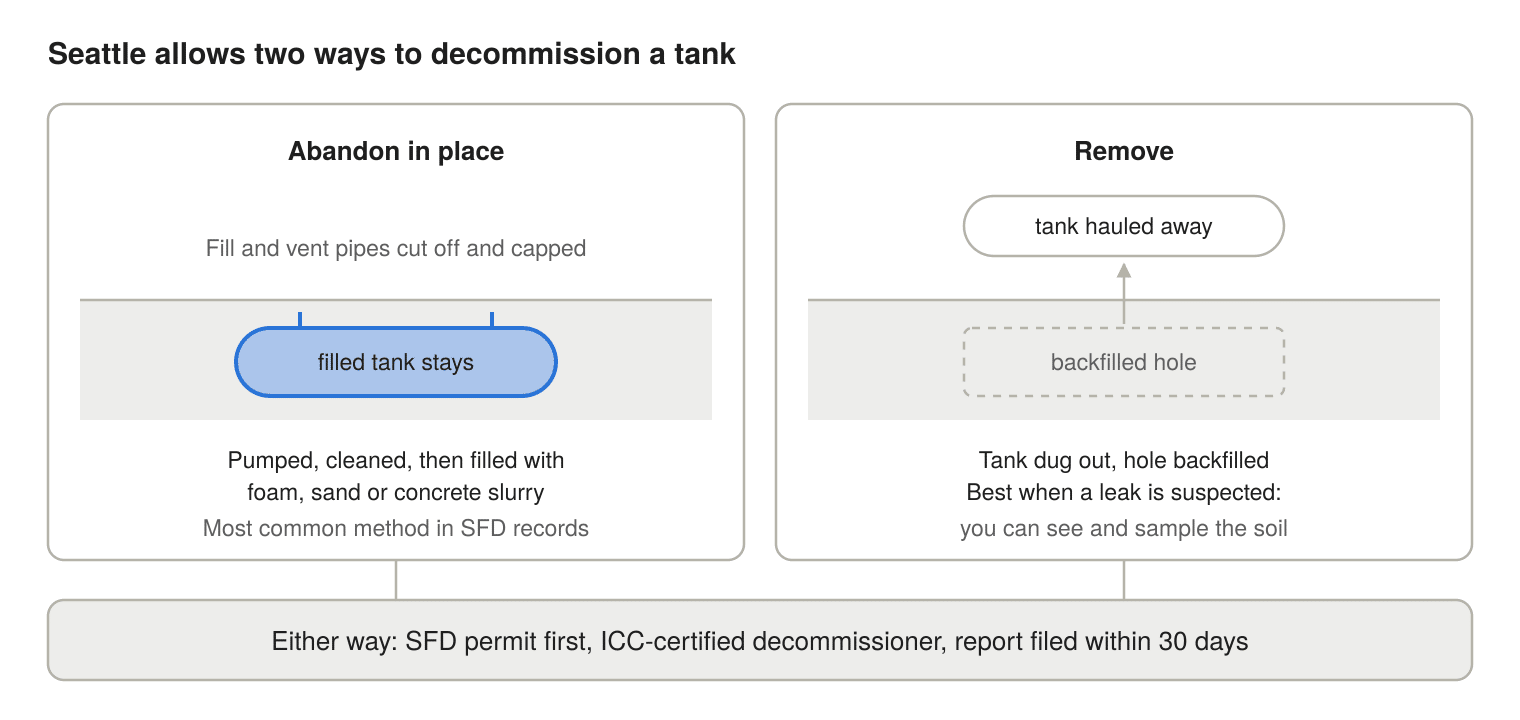
On removal versus abandonment, Matt Miner (my partner here at GHAH) has a simple rule: oil tanks are rarely removed. They’re usually abandoned in place, and that’s a normal, legal outcome, not a shortcut. The city data agrees with him. By our count, abandonments in place outnumber removals in SFD’s records by more than two to one. If a tank was properly decommissioned and left in the ground, it’s a decommissioned tank. I wouldn’t knock a dollar off a house for it.
The exception is a tank you suspect is leaking. Bellevue’s fire department says those should come out of the ground, and Filco, one of the longtime local decommissioners, says the same, because that’s how you get eyes (and a soil sample) on what’s underneath.
Same idea, different paperwork. Every city we checked requires a fire permit before a residential tank is decommissioned, but the details vary enough that you should call your own fire marshal before anyone starts digging.
| City | Who issues the permit | Notable details |
|---|---|---|
| Seattle | Seattle Fire Department, permit 6103 | $184 per tank; ICC-certified decommissioner; report within 30 days |
| Bellevue | Bellevue Fire Department (handout F-07) | Apply on MyBuildingPermit; ICC-certified decommissioner; report within 30 days |
| Redmond | Redmond Fire (Standard 10.00) | No fee for home heating oil tanks of 300 gallons or less; closure checklist due within 24 hours |
| Kirkland, Sammamish, Shoreline and others | Your local fire marshal or fire district | Check before you hire anyone |
One practical difference: Seattle publishes its tank records as open data, which makes a quick lookup easy. Outside Seattle, you may need a public records request to the fire department, so start early.
No. This is the biggest change of the last few years, and a lot of sellers haven’t caught up.
For nearly 30 years, Washington’s Pollution Liability Insurance Agency (PLIA) ran a free program that covered up to $60,000 of cleanup if a registered tank leaked. PLIA stopped taking new registrations in July 2020 and ended every remaining registration on August 1, 2025. It’s gone.
Fun lawyer fact (yes, I nerd out on this stuff): RCW 64.06.090 still requires every Washington home seller to make a notice available telling buyers that no-cost insurance may be available from PLIA. The statute is still on the books. The insurance isn’t. If you’re a buyer and you see that notice in your packet, now you know.
What replaced it is the Heating Oil Loan and Grant Program, and it works very differently:
PLIA itself warns that most completed cleanups cost more than the $60,000 grant, and that the program is running behind due to application volume. So I’d treat it as real help, not a safety net.
If you’re in Seattle and still heating with oil, the City’s Clean Heat program is the other lever: a $2,000 instant rebate on a qualifying heat pump, plus a $4,000 bonus for households between 81% and 150% of area median income on installs finished by May 30, 2027. Lower-income households may qualify for a free conversion through the Office of Housing. Every one of those paths requires decommissioning the tank to SFD standards.
What you actually know. Washington’s seller disclosure, Form 17 (RCW 64.06.020), asks in item 7.E whether there are any environmental concerns on the property, and it lists fuel storage tanks by name. Item 7.G separately asks about soil or groundwater contamination. Your answers are based on your actual knowledge, and once the buyer has the form they get three business days to walk away (unless they’ve waived that right).
The question I get most is whether to check “Don’t know.” If you genuinely don’t know, that’s the honest answer. HOWEVER, if there’s a capped fill pipe sticking out of your side yard, or the inspector flagged copper lines going nowhere in the basement, “No” is a bad answer. Guessing on a disclosure form is how sellers end up talking to lawyers like me after closing. And as you’ll see below, a seller who knew about a leak and didn’t disclose it loses one of the few defenses the cleanup law offers.
My advice to sellers of older Seattle homes is to find out before you list:
As for cost, published Seattle pricing for a clean decommission in place runs from about $700 to $5,000 depending on the company and the tank, and a full removal typically runs $5,000 to $10,000. If the soil is contaminated, the number climbs from there. Spending a few thousand dollars on your own timeline beats having a buyer’s inspector find the tank in the middle of escrow, when they’re the ones holding the leverage.
Still heating with oil? Whether to replace the furnace before you list is its own question. We ran 35,027 Seattle sales to see what oil heat does to your price, what converting costs, and which rebates are still real: Selling a Seattle Home With Oil Heat.
On any Seattle house built before 1978, we assume there was oil heat until something proves otherwise. Then we check three places.
First, the house itself. A fill pipe or vent pipe poking out of the yard or along the foundation, copper fuel lines cut off in the basement, or an old oil furnace are the giveaways. A good inspector will flag these.
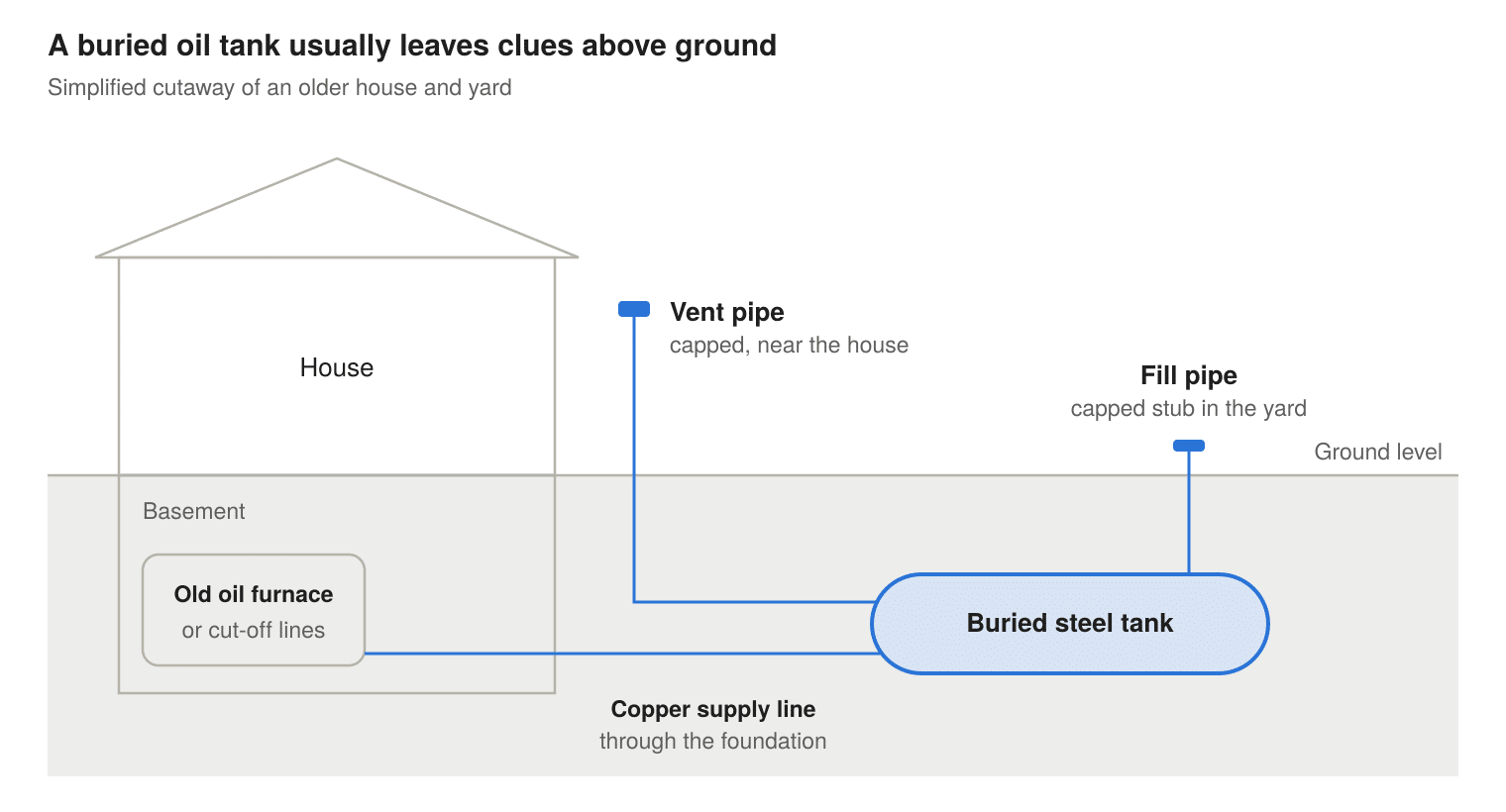
None of these proves there’s a tank, but any one of them is reason to pull the city record or order a sweep.
Second, the city record. We pull SFD’s tank data before writing an offer on older Seattle homes, and it regularly turns up things that aren’t in the listing, the seller’s inspection, or Form 17. This year we had one house where the record showed a 300-gallon tank decommissioned and left in place back in 2005, and a neighbor’s tank handled the same way in 2002. That’s a non-issue, and we told our buyers so. On another, the inspection mentioned a tank, and the city record showed it was never decommissioned, on a block where nearly every neighbor had a permit. That one got a very different conversation.
Third, if there’s no record and the signs say oil, a sweep. A tank locate uses a metal detector or ground-penetrating radar, and it’s a small cost next to a cleanup.
One caveat worth knowing: a decommissioning permit documents the tank, not the soil. If you want certainty about contamination, the only way to get it is a soil sample, and that takes the seller’s permission, which the standard inspection addendum doesn’t give you (more on that below). For a properly decommissioned tank, I treat sampling as optional comfort, not a must. For an undocumented tank, I’d want the seller to deal with it, or the price to reflect it, before we waive anything. The next section is the reason why.
This is the question I should have answered in the first version of this post, so here it is in full. First, the obligatory caveat, and I mean it: what follows is general information about how Washington’s cleanup law works, as I read the statute and the cases. It is not legal advice about your house. If you’re looking at a property with a known or suspected leak, hire an environmental attorney before you waive your contingencies. I’m happy to point you to one.
MTCA is Washington’s version of the federal Superfund law. Voters passed it as Initiative 97 in 1988, and the liability section (RCW 70A.305.040) is where a homebuyer’s exposure comes from.
It makes the current owner liable. The statute’s list of liable parties starts with “the owner or operator of the facility,” present tense, and “facility” means any place where a hazardous substance has come to be located. Petroleum is expressly a hazardous substance. So the yard with the leaking tank in it is a facility, and whoever holds title is an owner. It doesn’t matter that the leak happened in 1985 and you bought in 2027.
Liability is strict, joint and several. Strict means fault is irrelevant. Nobody has to prove you did anything wrong, and “I didn’t know” is not, by itself, a defense. Joint and several means any one liable party can be held for the whole cleanup, and then it’s on that party to go chase the others for their share. In practice, the party that gets chased first is the one who’s easiest to find and still owns the dirt. That’s you.
It gives everyone a lawsuit. RCW 70A.305.080 creates a private right of action. Anyone who pays for a cleanup can sue any other liable party (prior owners, for instance) to recover the cost, and the court splits it up on “equitable factors.” Attorney fees go to the prevailing party. That cuts both ways: it’s how a buyer who inherits a leak gets some money back from the seller, and it’s why a seller who knew and said nothing should expect to hear from a lawyer.
So the honest answer to “what liability might I have” is: if there’s a leaking tank on the property when you close, you own a cleanup, and the law will treat you as responsible for it from day one. Whether you can shift the cost to someone else is a separate question, and that’s where the defenses come in.
There is. It’s narrower than people think, and the Washington courts have made it narrower still.
The statute (RCW 70A.305.040(3)(b)) says a buyer isn’t liable if they can prove, by a preponderance of the evidence, that when they bought the property they had no knowledge or reason to know of the contamination, and that they did “all appropriate inquiry” into the property’s prior ownership and uses at the time. The defense is gone outright if you knew about a release and didn’t disclose it when you sold, or if you “caused or contributed to” the release.
Here’s what the cases have done with that language.
Grey v. Leach (2010). A Seattle-area couple sold a house with an oil furnace. The return lines to the buried tank had been leaking the entire time they lived there, and the court accepted that they had no idea. They were still not innocent purchasers. Because they operated the heating system, they “contributed to” the release, knowledge or not. The court also rejected their argument that burning heating oil in your own house is a protected “domestic use,” because the statute protects the use of the oil, not the leaking of it. And it held that the standard purchase and sale agreement did not shift cleanup liability between the parties, because it never said so.
Thomas Center Owners Association v. Robert E. Thomas Trust (2022). This one wasn’t a house (it was a condo association dealing with an old dry cleaner), but the holding applies to any owner. The association took over the property in July 1976. The dry cleaner’s contamination kept going until 1977 or 1978. That short overlap was enough. The Court of Appeals read the innocent purchaser exclusion to require the owner to prove that no release happened while they owned or controlled the property, and it said so even though it found the association “had no fault” and did nothing to cause the contamination. (The association still won on a different defense, for releases caused solely by an unrelated third party, which shows how fact-specific this gets.)
Put those together and the innocent purchaser defense realistically protects one kind of buyer: someone who bought after the leak had already stopped, did a real investigation before buying, and found nothing. If the tank is still weeping oil into the soil the day you close, you’re an owner during a release, and under Thomas Center the defense is gone no matter how clean your hands are.
And “all appropriate inquiry” is not a box you check by reading Form 17. I couldn’t find a Washington appellate decision spelling out exactly what inquiry is enough for a house, and the 2022 court borrowed from federal Superfund cases to fill the gap. Ecology’s own guidance says a court would look at things like the buyer’s specialized knowledge and whether the price paid reflected a discount for contamination. My read: the records check and the tank sweep are the inquiry a Seattle buyer can actually perform, and you should be able to show you did both. A soil sample would be better evidence, but as you’ll see in the next section, it’s rarely available to a buyer before closing.
One more thing for sellers, since the same cases apply to you. If you heated with oil from that tank, Grey v. Leach says you contributed to any leak from it, and the 2010 court in that case didn’t care that the leak was invisible. Your protection is the contract and the paperwork, not the statute. (A 2005 bill in Olympia would have exempted former owners whose tanks were PLIA-insured at the time of sale. It isn’t in the statute today, and the PLIA insurance program itself ended in 2025.)
This is the version of the question we hear most, so it gets its own answer. Say you bought a house where the oil system had been decommissioned before you ever saw it, the seller handed over the decommissioning certificate, and nobody tested the soil. Years later, someone finds old contamination under the tank. What’s your exposure?
Technically, you’re still a liable party. You’re the current owner, and MTCA liability is strict. Everything turns on the innocent purchaser defense, and on these facts I think you’re in about the best position a homebuyer can be in. You never ran the system, so you didn’t “contribute” to anything, which is the opposite of the sellers in Grey v. Leach. A tank that’s been pumped, cleaned, and filled isn’t leaking anymore, so there’s a good argument that no release happened on your watch, which is the fact Thomas Center turns on. And you did the inquiry a Seattle buyer actually does: you got the paperwork.
The weak spot is “reason to know.” Someone could argue that knowing a tank existed was reason to suspect contamination. If the decommissioning report itself noted holes, staining, or an odor, that argument gets a lot stronger, so read the report, not just the certificate.
What about the soil test you didn’t do? Our take is that it’s highly unlikely a buyer of a home with a decommissioned oil system needs a soil test to protect themselves. That would be a strange standard for a court to set. The NWMLS inspection addendum buyers sign expressly limits the oil tank inspection to finding out whether a tank is there, and sellers almost never allow digging. Requiring a soil sample before a buyer counts as “innocent” would put nearly every buyer of an older Seattle home on the hook for something they had no practical way to check, and courts are generally loath to read a statute in a way that opens up liability that broadly. I can’t point you to a Washington case that has decided this exact question for a house, so treat this as our read, not a guarantee.
Where this would realistically come up is when you sell. Your buyer may ask about the tank or want a test. Keep the decommissioning permit, the report, and your closing file together, because that’s your evidence. And if you ever do learn there’s contamination, disclose it. Knowing about a release and selling without saying so is the one sure way to lose the defense.
Less than the law review version of this post would suggest, and I’d rather tell you that now than after you’ve written an offer. Here’s the honest toolkit, in the order you’d use it.
Before you offer: the free stuff. Pull the fire department record. Permit plus completed decommissioning report equals a documented tank, and on a house that’s already on gas or electric, that’s the end of the inquiry. No record on a pre-1978 house means you keep going.
During inspection: the sweep. The standard NWMLS inspection addendum (Form 35) lets you check for the presence of an oil tank, so a metal detector or ground-penetrating radar locate is squarely within your rights. A few hundred dollars. If a tank turns up with no permit, you now know something the listing didn’t tell you.
What Form 35 does NOT let you do: sample the soil. The same addendum limits the oil tank inspection to determining whether a tank exists. Digging a test hole next to it needs the seller’s explicit permission, and in almost every deal I’ve seen, the answer is no. It’s slow, it’s invasive, and it raises questions the seller would rather not have answered on their own property. Asking also tends to get you labeled the difficult buyer, which costs you in every negotiation that follows. So on most deals you will close without knowing what’s in the soil. Plan on it.
If the house is already converted and the tank is undocumented: ask the seller to decommission it, with a permit, before closing. This is the one ask with a real chance, because it doesn’t touch the heating system. If they do it, you’re buying a documented tank, and if nobody has told you about a leak, you’re in about the best position the innocent purchaser defense allows. Many sellers will still say no, or will offer a credit instead. Take the credit if that’s what’s on the table, and do the decommissioning yourself the week you move in.
If the house still heats with oil: you’re buying the tank. Your lender needs a working heating system at closing, so asking the seller to remove the tank is asking them to install a new furnace for you. They won’t. And once you own and run that system, Grey v. Leach makes you an operator who “contributed” to any leak from it, whether or not you could ever prove the leak predated you (as a practical matter, you can’t). So the innocent purchaser defense is realistically off the table on an active-oil house. The protection is price. Budget for a permitted decommission plus a conversion (the City’s Clean Heat rebates help), and set aside a reserve for the possibility that the soil under the tank is bad. If that math doesn’t work at the asking price, that’s your answer.
If the seller discloses a past or suspected leak: ask for the No Further Action letter. PLIA’s technical assistance program reviews the consultant’s report and issues an opinion that the cleanup met MTCA standards. If the seller has one, the leak is a closed chapter. If they don’t, you’re being asked to buy an unfinished cleanup, and the price needs to say so, or you walk.
Shifting the liability by contract: possible in theory, rare in practice. Washington courts have said buyers and sellers can allocate cleanup liability between themselves by contract (it never changes what you owe the state or a neighbor, only who ultimately pays). In theory a seller could agree to stay on the hook for pre-closing releases on an addendum to the purchase agreement. The courts have rejected every attempt that relied on general language: “as is” didn’t do it in one case, and an inspection waiver didn’t do it in Grey v. Leach, because the standard forms say nothing about cleanup liability. Language that would work has to name the liability and say who bears it, for which releases, discovered when, and it has to be drafted and vetted by an independently licensed and insured attorney, not your agent. We haven’t done this on a deal yet. Sellers balk hard at accepting a liability most of them didn’t know existed until you brought it up, and the ones who agree will want to be paid for it. It’s a tool for a buyer holding the cards and a seller out of options.
After closing: decommission promptly, and apply to PLIA before you dig. If you bought the tank, take it out of service on your own timeline, with a permit, as part of the conversion. If you find contamination, the PLIA loan and grant program (up to $75,000 per tank, in application windows) pre-approves work and won’t reimburse anything you’ve already excavated, so the application comes first.
What I would NOT do is waive the inspection contingency on an older Seattle house with an unexplained fill pipe in the yard. The sweep is the one piece of information you’re entitled to, and giving it up to win a bidding war is how you end up owning a surprise.
Here’s the part the lawyer in me has to say carefully. Everything above is what the statute and the cases allow. What I can tell you from the agent side is that, as of now, we have heard of very few homeowners actually facing an MTCA claim or lawsuit over a residential heating oil tank, and none of our own clients has dealt with one. The reported cases are mostly commercial properties and the occasional neighbor-versus-neighbor fight. That doesn’t mean it can’t happen to you, and I can’t promise it will stay that way. It means the risk is real but, so far, uncommon.
Set that against the other fact: most of Seattle’s housing stock was built when oil was how you heated a house. If you treat an oil tank as a hard stop, you’ve crossed most of the city off your list, including nearly every pre-war Craftsman and mid-century rambler people move here for. As a practical matter, you can’t buy an older Seattle home while refusing to accept any tank risk at all.
So the honest framing is a weighing. On one side, a cleanup exposure that’s theoretically large and, in any given house, unknowable without a soil sample you probably can’t get. On the other, a house you want, in a city where that exposure comes standard. Most of our buyers land on buying the house with their eyes open: a records check, a sweep if the signs call for it, a credit or a price adjustment if there’s an undocumented tank, and a plan to decommission on their own schedule. When a specific house makes you nervous, we’ll walk through its risk profile with you, case by case. That’s a conversation, not a rule.
It becomes a cleanup project, and cleanup in Washington is measured against MTCA’s standards for soil and groundwater. In practice that means the tank comes out, an environmental consultant samples the soil, contaminated soil gets excavated and hauled away, and confirmation samples show what’s left meets the standard.
Two things are worth knowing as an owner. Cleanup responsibility under MTCA lands on the current owner of the property, even if the leak started decades before you bought it, which is exactly why buyers care so much (see above). And the cleanup isn’t finished in any useful sense until you can prove it. PLIA’s Technical Assistance Program can review the consultant’s report and issue a “No Further Action” opinion letter, which is the document a future buyer will want to see.
Can you make the people who caused it pay? On paper, yes. Liability under MTCA is joint and several, and every past owner who ran that oil system while it leaked is on the hook alongside you (that’s the Grey v. Leach holding, from the seller’s side of the table). RCW 70A.305.080 gives you a private right of action for contribution against any of them, the court divides the cost on “equitable factors,” and the prevailing party gets attorney fees. There’s a deadline: three years from the date your cleanup is confirmed to meet MTCA standards.
In practice, I’d think hard before filing. You have to find the prior owners, they have to be alive, in the state, and worth suing, and then you have to prove the leak happened on their watch, which usually means expert testimony about the age of the contamination. “Equitable factors” means a judge may hand you a fraction of the bill, not all of it. Against a $20,000 cleanup, the lawsuit can cost more than it recovers, and the fee-shifting cuts both ways if you lose. Where it does make sense is the bigger case: a six-figure cleanup, a seller who’s still local and solvent, and especially a seller who knew and said nothing on Form 17, because that seller has also lost the innocent purchaser defense and probably has a disclosure problem on top of MTCA. If you’re in that spot, this is the point where you stop reading a real estate blog and call an environmental attorney.
Cost is the scary part. Published Seattle figures for removal with contaminated soil start around $10,000 to $15,000, and PLIA says most full cleanups in its program run past $60,000. Groundwater involvement is what pushes a job from bad to ugly. If you’re facing this, get two consultants’ opinions and apply to the PLIA program before any work starts, since it won’t pay for work it didn’t approve first.
Is it illegal to have an old oil tank in Seattle? Having one isn’t. Leaving an out-of-service tank undecommissioned is a Seattle Fire Code violation, and the fix is a permitted decommissioning.
Do Seattle oil tanks have to be removed by 2028? Not under any law we can find as of November 2026. The 2019 ordinance only directed the City to make a plan, and the tax that was going to fund it was repealed in 2022.
Is it OK to leave a decommissioned tank in the ground? Yes, if it was done with a permit. Abandonment in place is the most common method in Seattle’s records.
Can I be held responsible for a leak that happened before I bought the house? Yes. Under MTCA the current owner is a liable party, and liability is strict. You can sue prior owners to recover costs, but the cleanup is yours to manage first.
Doesn’t the innocent purchaser defense protect me? Only if you investigated before buying, found nothing, and no release happened while you owned the property. Washington courts have held that an owner during an ongoing release, or a seller who operated a leaking oil system, is not an innocent purchaser, even without knowledge.
I bought a house with a decommissioned tank and never tested the soil. Am I exposed? Technically you’re a liable party if contamination turns up, but you have a strong innocent purchaser argument: you never ran the system, the tank wasn’t leaking on your watch, and you relied on the permit paperwork. Our take is that courts are very unlikely to require a soil test that the standard inspection forms don’t even allow.
Can I still register my tank for free PLIA insurance? No. That program ended on August 1, 2025. PLIA now offers loans and grants, up to $75,000 per tank, in application windows.
Will an oil tank show up on the title report? No. Title commitments exclude environmental and permit records. Check the fire department’s records instead.
Do I have to disclose a decommissioned tank when I sell? Form 17 asks about fuel storage tanks, and a decommissioned tank is still a tank. Disclose it and attach the paperwork, which usually reassures buyers more than it worries them.
Forget the 2028 deadline, because there isn’t one. What matters is whether the tank has a permit and a decommissioning report. If it does, I wouldn’t lose sleep over it. If it doesn’t, find that out before you write the offer, because once you own the house the cleanup is yours under MTCA, and the law gives you little room to argue otherwise. Then decide what the risk is worth to you on that particular house. For most buyers of older Seattle homes, it’s a price conversation, not a reason to walk, and we’re glad to have it with you address by address.
If you’re buying or selling an older home in Seattle or on the Eastside, send us the address and we’ll pull the tank record before you list or write an offer. You can reach the team at (425) 276-1903 or team@gethappyathome.com.
This post is general information about Washington and Seattle rules as of November 2026, written by a real estate agent who also happens to be a Washington attorney. It is not legal advice for your situation, and reading it doesn’t make me your lawyer. If you have a tank problem with real money attached, talk to an environmental attorney before you sign anything.
Sources for the liability sections: RCW 70A.305.020, .040 and .080; Car Wash Enterprises, Inc. v. Kampanos, 74 Wn. App. 537 (1994); Grey v. Leach, 158 Wn. App. 837 (2010); Thomas Center Owners Ass’n v. Robert E. Thomas Trust, No. 81987-9-I (Wash. Ct. App. Jan. 3, 2022); Washington Department of Ecology, Contaminated Property Considerations (Pub. 22-09-021).