Seattle Residential Underground Oil Storage Tank FAQ
- Ryan Palardy,
- November 4, 2026



By Ryan Palardy, JD, Real Estate Agent and Washington Attorney, Get Happy at Home at Compass
As far as I can tell, no. And I’ve looked pretty hard.
Every few months a buyer asks me some version of “don’t all the oil tanks have to be out of the ground by 2028?” I get why. Plenty of local real estate blogs say so, flatly, and some of them were written this year. So I put my lawyer hat on and went back to the actual ordinance.
In September 2019, the Seattle City Council passed Ordinance 125934. It did two things. It created a 23.6 cent per gallon tax on heating oil, and it told city departments to come up with a plan for regulating oil tanks, with the stated intent that tanks be decommissioned or replaced by December 31, 2028. A plan, not a mandate. The Seattle Times even ran a clarification on exactly that point back in 2019.
The departments delivered their recommendation in 2020. The big idea was to explore adding a decommissioning requirement to a future version of the Seattle Fire Code. Then the funding fell apart. The oil tax was delayed three times during COVID, never collected a dime, and the Council repealed it in November 2022.
Today, the City’s own Clean Heat page talks about a goal of helping every remaining oil-heated home switch by 2030, using rebates. The Fire Department’s decommissioning memo, updated March 2024, doesn’t mention 2028 at all. If the City adopts a real deadline, I’ll update this post the same day.
That said, there is a rule on the books right now that catches far more Seattle homeowners than a 2028 deadline ever would. More on that in a minute.
Because for decades, oil was how Seattle heated its houses. When natural gas and electric heat took over, most owners switched the furnace and left the tank right where it was, usually under the side yard or the front lawn.
The City estimates 8,000 to 10,000 homes still heat with oil, down from roughly 18,000 in 2018. That’s just the active ones. The Fire Department’s public tank records hold tens of thousands of decommissioned residential tanks, and those records only start in 1996, so anything handled before then simply isn’t there.
The tanks themselves are old steel. When the City studied this in 2020, it estimated that more than one in four tanks were already leaking. My guess is that’s conservative, since nobody tests a tank they’ve forgotten about.
Less of the government than you’d think. The federal underground storage tank rules carve out heating oil stored for use on the premises, and Washington’s Department of Ecology says plainly that it doesn’t regulate tanks used only for home heating oil. Those rules are for gas stations.
What’s left is two layers. Your city’s fire code governs taking a tank out of service. And if a tank has leaked, Washington’s Model Toxics Control Act (MTCA, chapter 70A.305 RCW) sets the cleanup standard the soil has to meet.
One more thing that surprises buyers: title insurance won’t help you here. A standard title commitment expressly excludes environmental and permitting records from what it searches, so an oil tank will never show up on title. You have to go look.
The rule I promised: under the Seattle Fire Code (section 5704.2.13 in the 2021 edition), a residential heating oil tank that’s no longer in use has to be decommissioned, along with its piping. The City’s own oil tank flyer puts it at tanks out of service for a year or more.
Read that again if you switched to gas or a heat pump years ago and never called anyone about the tank. Technically, you’re out of compliance right now. Nobody is going to show up with a ground-penetrating radar and a citation (as far as I know, SFD doesn’t go looking), but it will come up the day you sell.
Doing it properly in Seattle looks like this:
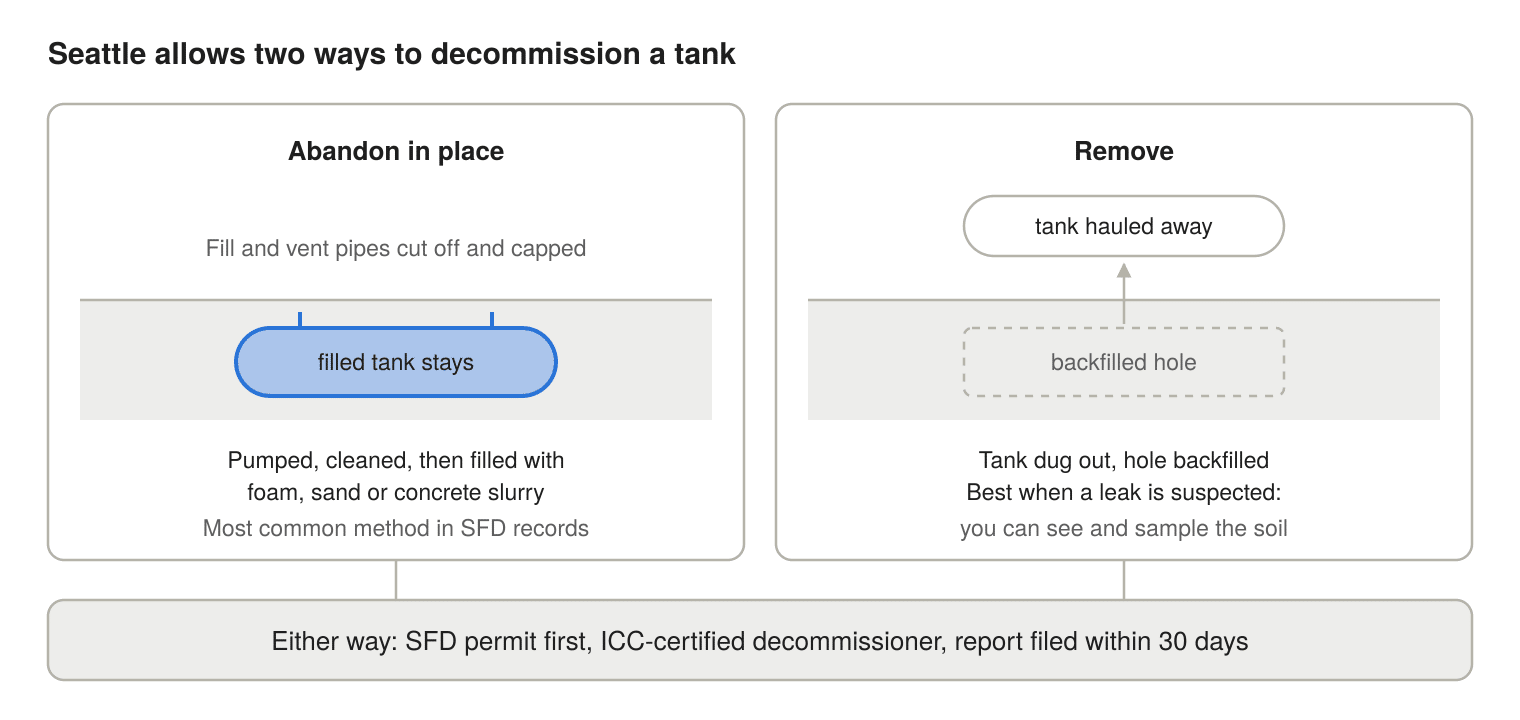
On removal versus abandonment, Matt Miner (my partner here at GHAH) has a simple rule: oil tanks are rarely removed. They’re usually abandoned in place, and that’s a normal, legal outcome, not a shortcut. The city data agrees with him. By our count, abandonments in place outnumber removals in SFD’s records by more than two to one. If a tank was properly decommissioned and left in the ground, it’s a decommissioned tank. I wouldn’t knock a dollar off a house for it.
The exception is a tank you suspect is leaking. Bellevue’s fire department says those should come out of the ground, and Filco, one of the longtime local decommissioners, says the same, because that’s how you get eyes (and a soil sample) on what’s underneath.
Same idea, different paperwork. Every city we checked requires a fire permit before a residential tank is decommissioned, but the details vary enough that you should call your own fire marshal before anyone starts digging.
| City | Who issues the permit | Notable details |
|---|---|---|
| Seattle | Seattle Fire Department, permit 6103 | $184 per tank; ICC-certified decommissioner; report within 30 days |
| Bellevue | Bellevue Fire Department (handout F-07) | Apply on MyBuildingPermit; ICC-certified decommissioner; report within 30 days |
| Redmond | Redmond Fire (Standard 10.00) | No fee for home heating oil tanks of 300 gallons or less; closure checklist due within 24 hours |
| Kirkland, Sammamish, Shoreline and others | Your local fire marshal or fire district | Check before you hire anyone |
One practical difference: Seattle publishes its tank records as open data, which makes a quick lookup easy. Outside Seattle, you may need a public records request to the fire department, so start early.
No. This is the biggest change of the last few years, and a lot of sellers haven’t caught up.
For nearly 30 years, Washington’s Pollution Liability Insurance Agency (PLIA) ran a free program that covered up to $60,000 of cleanup if a registered tank leaked. PLIA stopped taking new registrations in July 2020 and ended every remaining registration on August 1, 2025. It’s gone.
Fun lawyer fact (yes, I nerd out on this stuff): RCW 64.06.090 still requires every Washington home seller to make a notice available telling buyers that no-cost insurance may be available from PLIA. The statute is still on the books. The insurance isn’t. If you’re a buyer and you see that notice in your packet, now you know.
What replaced it is the Heating Oil Loan and Grant Program, and it works very differently:
PLIA itself warns that most completed cleanups cost more than the $60,000 grant, and that the program is running behind due to application volume. So I’d treat it as real help, not a safety net.
If you’re in Seattle and still heating with oil, the City’s Clean Heat program is the other lever: a $2,000 instant rebate on a qualifying heat pump, plus a $4,000 bonus for households between 81% and 150% of area median income on installs finished by May 30, 2027. Lower-income households may qualify for a free conversion through the Office of Housing. Every one of those paths requires decommissioning the tank to SFD standards.
What you actually know. Washington’s seller disclosure, Form 17 (RCW 64.06.020), asks in item 7.E whether there are any environmental concerns on the property, and it lists fuel storage tanks by name. Item 7.G separately asks about soil or groundwater contamination. Your answers are based on your actual knowledge, and once the buyer has the form they get three business days to walk away (unless they’ve waived that right).
The question I get most is whether to check “Don’t know.” If you genuinely don’t know, that’s the honest answer. HOWEVER, if there’s a capped fill pipe sticking out of your side yard, or the inspector flagged copper lines going nowhere in the basement, “No” is a bad answer. Guessing on a disclosure form is how sellers end up talking to lawyers like me after closing.
My advice to sellers of older Seattle homes is to find out before you list:
As for cost, published Seattle pricing for a clean decommission in place runs from about $700 to $5,000 depending on the company and the tank, and a full removal typically runs $5,000 to $10,000. If the soil is contaminated, the number climbs from there. Spending a few thousand dollars on your own timeline beats having a buyer’s inspector find the tank in the middle of escrow, when they’re the ones holding the leverage.
On any Seattle house built before 1978, we assume there was oil heat until something proves otherwise. Then we check three places.
First, the house itself. A fill pipe or vent pipe poking out of the yard or along the foundation, copper fuel lines cut off in the basement, or an old oil furnace are the giveaways. A good inspector will flag these.
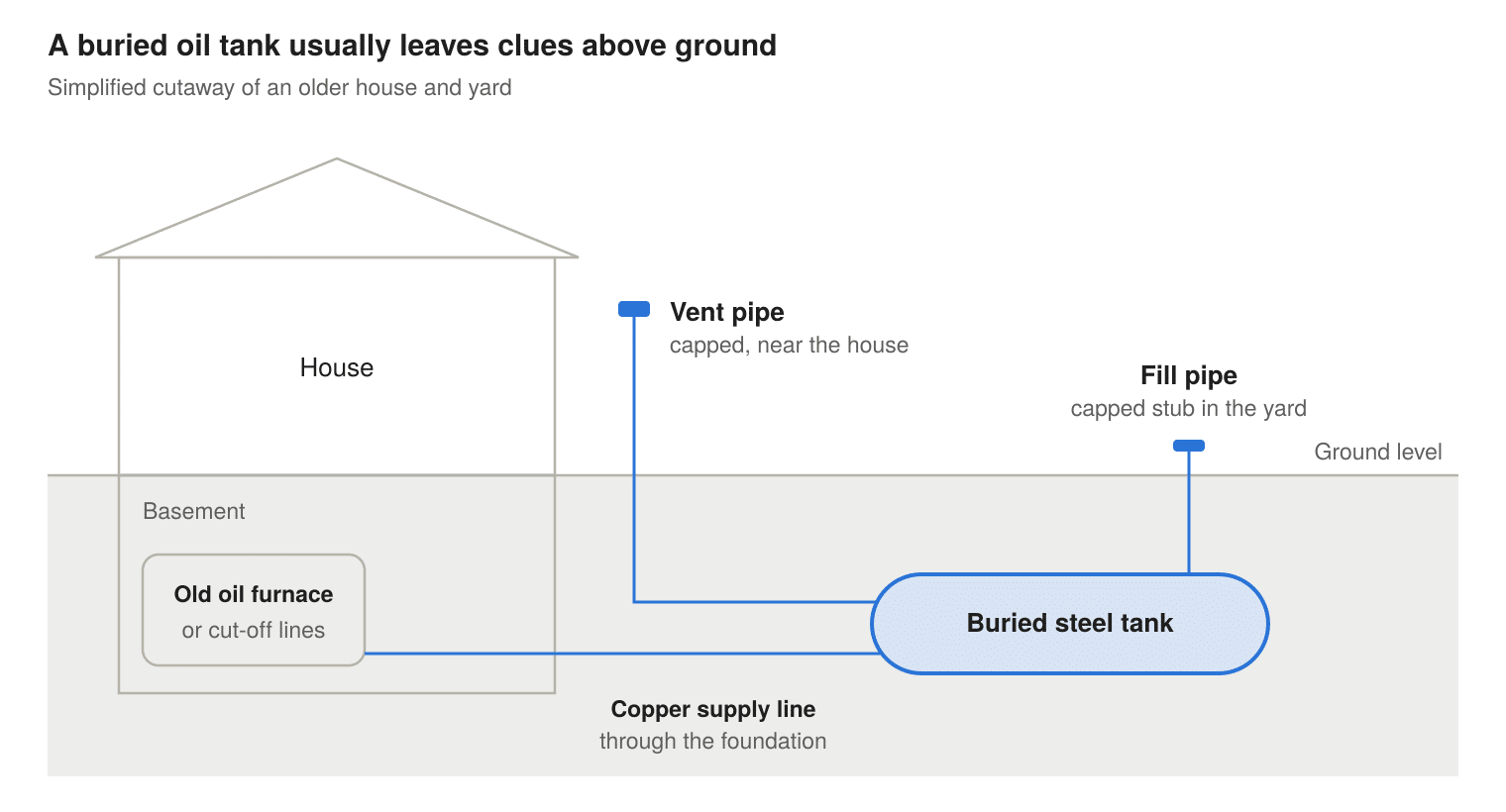
None of these proves there’s a tank, but any one of them is reason to pull the city record or order a sweep.
Second, the city record. We pull SFD’s tank data before writing an offer on older Seattle homes, and it regularly turns up things that aren’t in the listing, the seller’s inspection, or Form 17. This year we had one house where the record showed a 300-gallon tank decommissioned and left in place back in 2005, and a neighbor’s tank handled the same way in 2002. That’s a non-issue, and we told our buyers so. On another, the inspection mentioned a tank, and the city record showed it was never decommissioned, on a block where nearly every neighbor had a permit. That one got a very different conversation.
Third, if there’s no record and the signs say oil, a sweep. A tank locate uses a metal detector or ground-penetrating radar, and it’s a small cost next to a cleanup.
One caveat worth knowing: a decommissioning permit documents the tank, not the soil. If you want certainty about contamination, the only way to get it is a soil sample. For a properly decommissioned tank, I treat that as optional comfort, not a must. For an undocumented tank, I’d want the seller to deal with it, or the price to reflect it, before we waive anything.
It becomes a cleanup project, and cleanup in Washington is measured against MTCA’s standards for soil and groundwater. In practice that means the tank comes out, an environmental consultant samples the soil, contaminated soil gets excavated and hauled away, and confirmation samples show what’s left meets the standard.
Two things are worth knowing as an owner. Cleanup responsibility under MTCA can land on the current owner of the property, even if the leak started decades before you bought it, which is exactly why buyers care so much. And the cleanup isn’t finished in any useful sense until you can prove it. PLIA’s Technical Assistance Program can review the consultant’s report and issue a “No Further Action” opinion letter, which is the document a future buyer will want to see.
Cost is the scary part. Published Seattle figures for removal with contaminated soil start around $10,000 to $15,000, and PLIA says most full cleanups in its program run past $60,000. Groundwater involvement is what pushes a job from bad to ugly. If you’re facing this, get two consultants’ opinions and apply to the PLIA program before any work starts, since it won’t pay for work it didn’t approve first.
Is it illegal to have an old oil tank in Seattle? Having one isn’t. Leaving an out-of-service tank undecommissioned is a Seattle Fire Code violation, and the fix is a permitted decommissioning.
Do Seattle oil tanks have to be removed by 2028? Not under any law we can find as of November 2026. The 2019 ordinance only directed the City to make a plan, and the tax that was going to fund it was repealed in 2022.
Is it OK to leave a decommissioned tank in the ground? Yes, if it was done with a permit. Abandonment in place is the most common method in Seattle’s records.
Can I still register my tank for free PLIA insurance? No. That program ended on August 1, 2025. PLIA now offers loans and grants, up to $75,000 per tank, in application windows.
Will an oil tank show up on the title report? No. Title commitments exclude environmental and permit records. Check the fire department’s records instead.
Do I have to disclose a decommissioned tank when I sell? Form 17 asks about fuel storage tanks, and a decommissioned tank is still a tank. Disclose it and attach the paperwork, which usually reassures buyers more than it worries them.
Ignore the 2028 scare and pay attention to the paperwork. A buried tank with a permit and a decommissioning report is a footnote. A buried tank with no record is a negotiation, and the side that finds it first usually wins that negotiation.
If you’re buying or selling an older home in Seattle or on the Eastside, send us the address and we’ll pull the tank record before you list or write an offer. You can reach the team at (425) 276-1903 or team@gethappyathome.com.
This post is general information about Washington and Seattle rules as of November 2026, not legal advice for your situation.