Selling a Seattle Home With Oil Heat (2026): What It Costs You and Whether to Convert
- Ryan Palardy,
- November 18, 2026



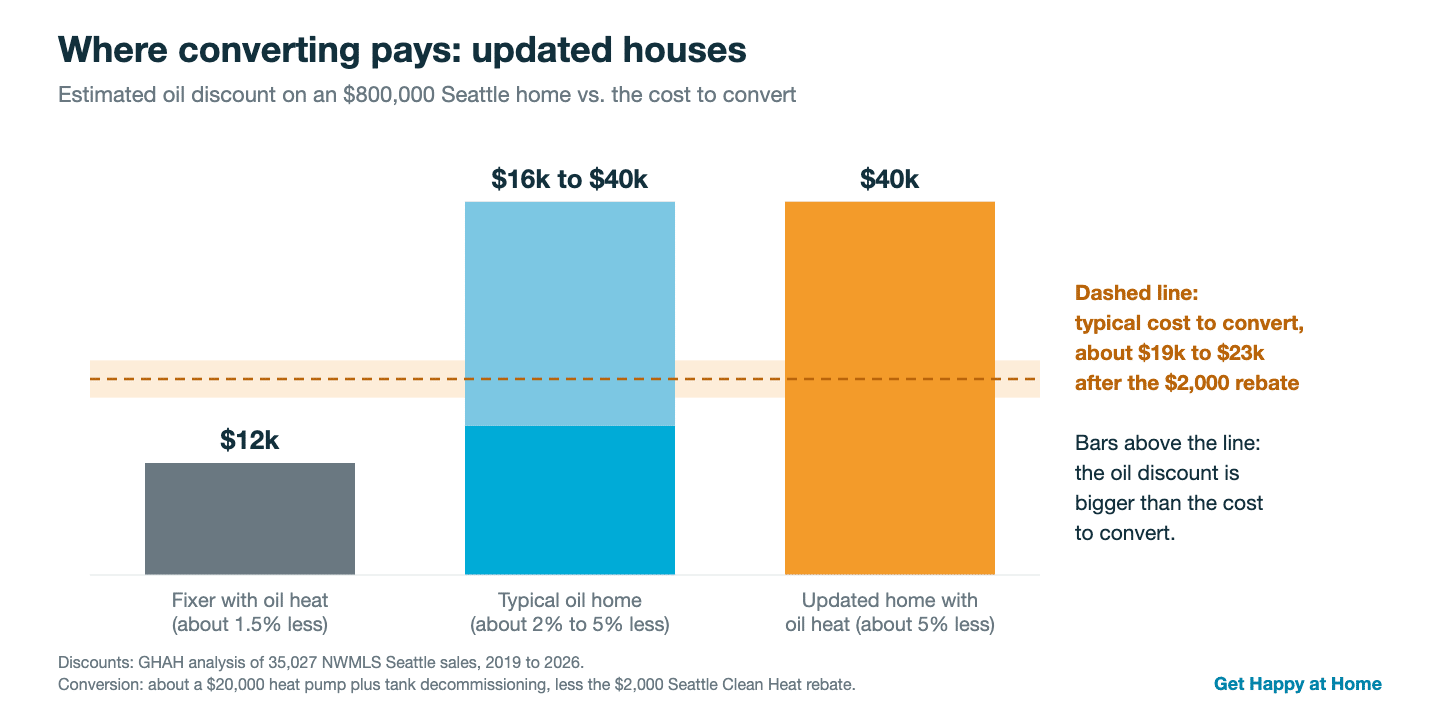
If the rest of the house is updated, usually yes. If it’s a fixer, no. Oil-heated Seattle homes sell for about 2% to 5% less than comparable gas-heated homes, which is roughly $16,000 to $40,000 on a typical $800,000 oil house. That comes from 35,027 Seattle sales in our NWMLS database (2019 through November 2026), checked against published research. Converting to a heat pump and decommissioning the tank runs about $19,000 to $23,000 at the commonly cited system price, after the one rebate every Seattle oil home can still get. The discount is biggest (about 5%) on homes that are otherwise updated and smallest (about 1.5%) on fixers. Oil homes don’t take longer to sell. Buyers still buy them. They just pay less, and under Washington’s cleanup law a leak that happened on your watch can follow you after closing.
Short on time? Skip to the math, the rebates that are real right now, or whether to test the soil.
Here is a conversation I have a few times a year. A seller has done the kitchen, the roof and the windows, and the house looks great. Then we get to the basement and there’s a furnace old enough to vote in the Reagan election, fed by a tank buried somewhere under the rhododendrons. “Do I really need to deal with that?”
For years my answer was a shrug and “probably.” I wanted a better answer, so I pulled every Seattle sale in our NWMLS database since 2019 and compared the oil houses to everything else. I’ll admit the first number I got was too high, and I spent a while knocking it down before I believed it. This post is what was left standing.
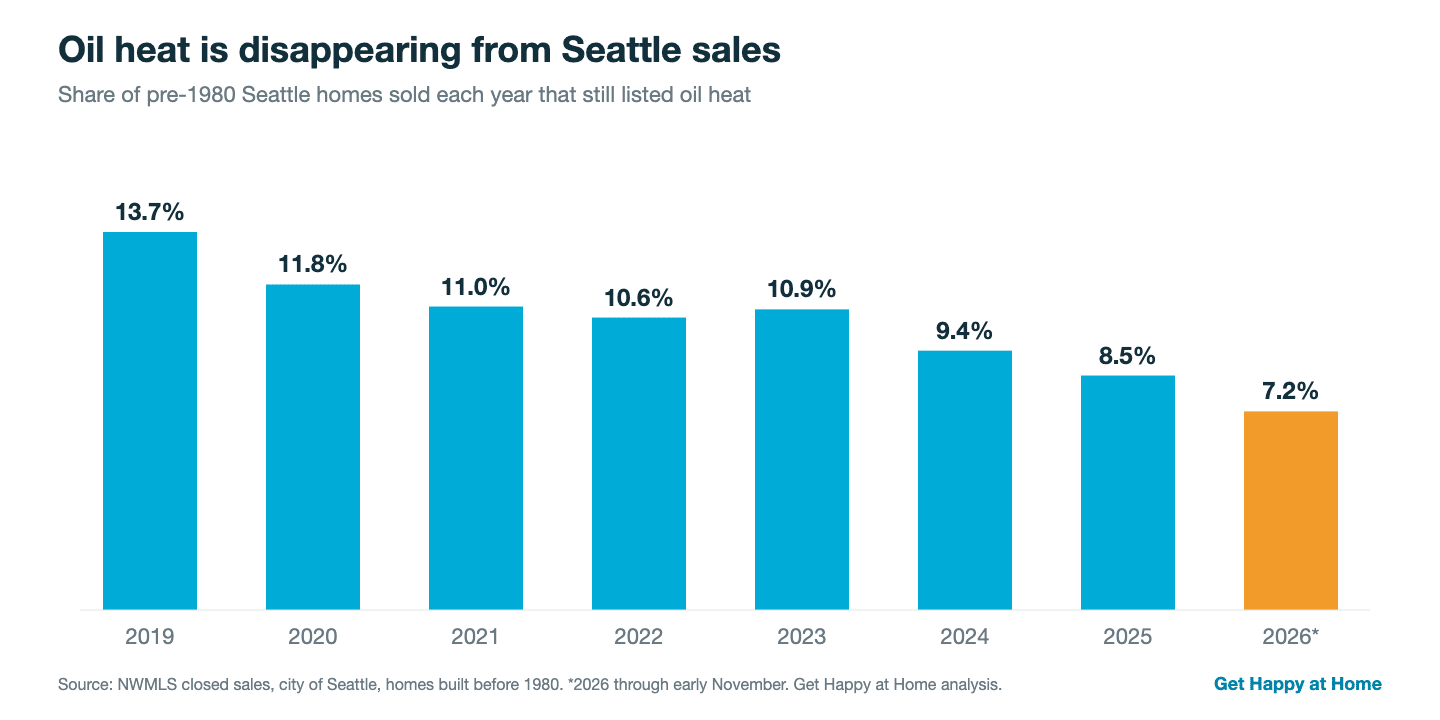
This post is about the furnace: whether to replace it before you sell and what it does to your price. If your questions are about the tank itself (finding one, permits, decommissioning, or what a buyer can be on the hook for), our Seattle oil tank FAQ covers that in detail.
About 2% to 5% less than a comparable gas-heated home. On paper the gap looks far worse than that, and most of the difference is not the furnace.
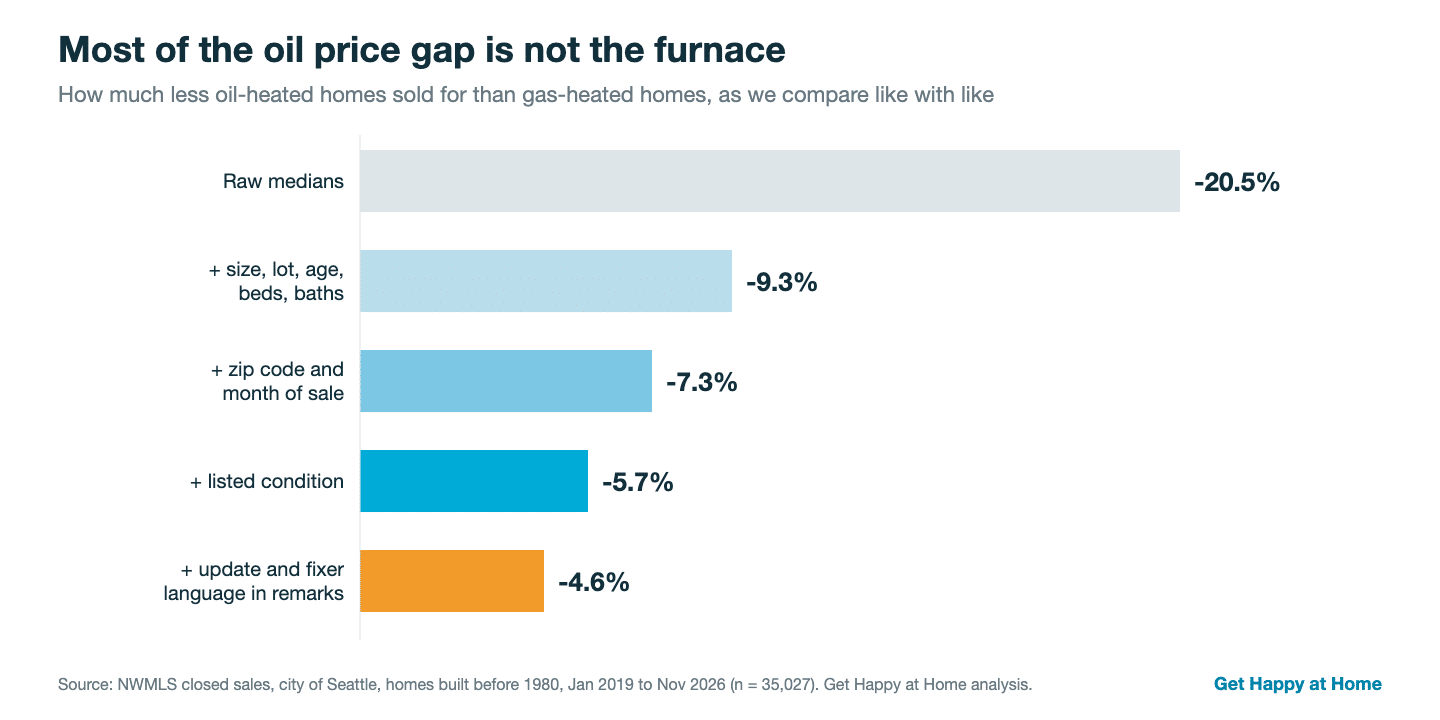
I looked at 35,027 sales of Seattle homes built before 1980, of which 3,723 were heated with oil. The typical oil house sold for $800,000 and the typical gas house for $975,000. That’s a 20% gap, and if I were selling heat pumps I’d stop right there and put it on a billboard.
But oil houses are smaller, sit in different zip codes, and are in rougher shape on average. So I compared like with like, one layer at a time:
| What we held equal | Oil vs. gas | Oil vs. heat pump |
|---|---|---|
| Nothing (raw medians) | -20.5% | -19.8% |
| Size, lot, age, beds, baths | -9.3% | -8.3% |
| Plus zip code and month of sale | -7.3% | -10.9% |
| Plus the condition the agent reported | -5.7% | -8.5% |
| Plus update and fixer language in the listing remarks | -4.6% | -7.2% |
Every control I added made the number smaller, which tells you the 4.6% probably still has some “dated house” in it that I can’t see from a spreadsheet. That’s why I say 2% to 5% and not 4.6%.
The outside research lands in the same place. A study of 19,008 house sales in Finland found oil heat took 2.3% off the price. An economist who compared oil and gas homes in Massachusetts over 21 years found buyers price the fuel bill in almost dollar for dollar. And if you just add up what a buyer faces (a conversion, plus some chance the tank has leaked), you get $20,000 to $40,000 without any statistics at all.
One thing the data did NOT show: oil houses don’t sit. Median time to pending was 7 days for oil and 6 for gas, and oil listings were no more likely to be pulled without selling. Seattle buyers aren’t running from oil. They’re doing math.
Both, and which one matters more depends on your house.
Oil heat tends to travel with long ownership and deferred updates. In the same 35,027 sales:
| Signal in the listing | Oil homes | Gas homes |
|---|---|---|
| “Fixer,” “as-is,” “TLC,” or “investor” in the remarks | 24% | 10% |
| Condition listed as Fixer, Fair or Average | 16% | 7% |
| Condition listed as Remodeled or Very Good | 19% | 34% |
| “One owner” or “same family since” language | 4.6% | 1.7% |
So a buyer who sees “oil” in a listing often reads it as shorthand for “nobody has touched this place since 1974.” Sometimes that’s true. When it isn’t, the oil furnace is the one thing dragging an otherwise finished house backward, and that’s where it costs the most:
Not sure which group your house falls in? Send us the address. We’ll run your comps with and without oil and tell you whether converting is worth it before you list. Send us the address or call (425) 276-1903.
Mostly the tank, partly the bill, and a little bit the summer.
Yes, if it leaked while you were the one using it. Lawyer hat on for four paragraphs, and this is general information, not legal advice for your house.
Washington’s cleanup law, the Model Toxics Control Act, treats heating oil as a hazardous substance and makes owners “strictly liable, jointly and severally” for cleanup. It reaches the person who owned or operated the system when the release happened, in addition to whoever owns the property now. Selling the house doesn’t take your name off that list.
The case to know is Grey v. Leach (2010). Former owners who had run an oil system with leaking lines were sued by their buyers after the sale. They argued they were innocent purchasers and that heating a home is ordinary domestic use. They lost on both, and the standard purchase agreement didn’t shift the liability to the buyer either.
The timing is the part sellers don’t expect. A later owner who pays for a cleanup can sue prior owners for contribution, and the three-year clock starts when the cleanup is confirmed complete, not when you closed. The winner recovers attorney fees.
Now the perspective. These lawsuits are rare. None of our clients has been on either end of one, and I’d be overselling it if I told you a process server is coming. But the longer oil keeps going into a 60-year-old steel tank, the more of it can end up in the dirt, and every gallon that does is yours. Stopping use and decommissioning with a permit is the one piece of this you fully control.
Most Seattle sellers don’t, and in most cases I wouldn’t either. But you should make that call knowing both sides of it.
What most people do: hire a certified decommissioner, pull the $184 Seattle Fire Department permit, have the tank pumped, cleaned and filled in place, and keep the signed decommissioning report for the disclosure file. No soil sample. In the Fire Department’s records, tanks abandoned in place outnumber tanks removed by more than two to one. In my experience that report is what nearly every Seattle buyer accepts, and our oil tank FAQ explains why we think a buyer in that position is very unlikely to need more.
| Testing the soil: the case for | Testing the soil: the case against |
|---|---|
| A clean result is the strongest document you can hand a buyer. It ends the question. | You can’t un-know a bad result. Form 17 asks what you know about soil contamination, and you have to answer it truthfully. |
| If it’s dirty, you find out on your timeline and not in the middle of escrow. | A confirmed leak means a cleanup that starts around $10,000 to $15,000 and can pass $60,000, and it can take months. |
| You can apply for the state’s cleanup grant before you list. The program has application windows and must approve the work before it starts. | Seattle buyers rarely ask. The standard inspection form only lets a buyer find out whether a tank exists; they can’t sample your soil without your permission. |
| A leak you catch now stops spreading, which caps your own exposure. | If you pull the tank out of the ground, the soil is exposed. A crew that sees contamination will tell you it has to be dealt with. |
When I would test: if you have a reason to think it leaked (an oil smell in the basement, staining, a tank that’s been losing oil), if you’re removing the tank anyway, or if you personally want to know what your kids are playing on top of. In some states a soil test is a standard part of every sale. Here it isn’t, and I don’t think you need to be the first on your block.
What I would never do: test, get a bad result, and stay quiet about it. If you know about a release, disclose it. That’s the law, it’s the right thing to do, and hiding it is the fastest way to turn a manageable problem into the lawsuit described above. Our Form 17 guide covers what the form asks.
Plan on somewhere between $10,000 and $40,000 installed. That’s a wide range because houses are different, and I’d rather give you an honest wide range than a precise wrong number. The figure you’ll see most often for a typical Seattle oil conversion is about $20,000 before rebates, and the national average is about $15,400. Quotes we’ve seen on our clients’ and our own renovation projects have covered that whole $10,000 to $40,000 spread.
The three things that move the price most:
For bids, we send clients to Greenwood Heating and Home Services. They do excellent work and they are not the cheapest, so get a second and third quote. Two longtime local outfits whose customers regularly mention fair pricing on oil-to-heat-pump jobs are Olson Energy Service and Glendale Heating in Burien. If you want the City rebate below, at least one bid has to come from a contractor on the City’s Clean Heat participating contractor list. For the tank, the longtime local decommissioner is Filco.
What you get for the money: a system that’s two to four times more efficient than burning oil, air conditioning, filtered air, and no more delivery truck. In our data, heat pump homes sold about 3% above comparable gas homes, and published studies put the premium anywhere from under 1% to 7%. I’d treat that as a bonus and not as the reason to do it.
Fewer than the internet will tell you. A lot of rebate pages are still advertising money that expired. Here is what I could confirm on the official program pages as of November 18, 2026.
| Program | Amount | Status | The fine print |
|---|---|---|---|
| Seattle Clean Heat base rebate | $2,000 | Available. Any income. | Instant, on the contractor’s invoice. Seattle home, oil is your primary heat, qualifying Mitsubishi Electric heat pump, participating contractor, and the tank decommissioned to Fire Department standards. |
| Seattle City Light heat pump discount | $300 to $600 | Available. Any income, any existing fuel. | Instant, through the contractor, sized by the system’s efficiency rating. Ask your contractor whether it applies on top of Clean Heat on your job. |
| Free conversion for income-qualified households | Full cost, including the tank | Available through the Seattle Office of Housing. | For households under the City’s income limits. Call (206) 684-0244 for the current limits and wait time. |
| Clean Heat bonus rebate | $4,000 | Don’t count on it. | For moderate-income households. The City’s page says it covered installations completed by September 30, 2026, and I found no posted extension. Ask your contractor. |
| Federal heat pump tax credit (25C) | $2,000 | Gone. | Ended for anything installed after December 31, 2025. |
| Federal home energy rebates | Up to $8,000 | Not open. | The City’s page lists these as not yet available in Washington. |
| State heating oil loan and grant program (PLIA) | Up to $75,000 | Available, for leaks. | This is cleanup money, not heat pump money: up to $7,000 for a site assessment and up to $60,000 in grants for cleanup, with loans beyond that. The current window runs November 2 to December 17, 2026, and the agency has to approve work before it starts. |
Two details that trip up sellers. First, the Clean Heat rebate requires a WORKING oil furnace. The City’s participation form says homes with a dead furnace don’t qualify, so don’t wait for it to fail. Second, Puget Sound Energy’s heat pump rebates are aimed at PSE customers switching from gas, not Seattle oil homes.
Outside Seattle, the programs are different: Shoreline has its own $2,500 rebate for oil and gas conversions, and King County runs an income-based program. Check with your city before assuming any of the above applies.
| Convert before listing | Sell with oil | |
|---|---|---|
| Out of pocket | About $19,000 to $23,000 for a $20,000 system, less the $2,000 rebate, plus $900 to $5,200 to decommission the tank with a permit. Your house could land anywhere in the $10,000 to $40,000 range. | $0 up front |
| Likely effect on price | Removes the oil discount. No promise you get every dollar back. | About 2% to 5% less: $16,000 to $40,000 on an $800,000 house |
| Inspection negotiation | One less thing on the report | Expect a tank locate and a credit request |
| Liability going forward | You’ve stopped adding oil to an old tank and have the paperwork | The tank stays in service under the next owner, and you were the last one before them |
How I’d actually call it:
No. Nothing in Seattle or Washington law requires it, and there is no binding deadline to stop using oil heat as of November 2026. It’s a pricing decision. Oil-heated Seattle homes sold for about 2% to 5% less than comparable gas-heated homes in our analysis of 35,027 sales.
About 2% to 5%, or $16,000 to $40,000 on a typical $800,000 oil-heated home. The effect is about 5% on updated homes and about 1.5% on fixers.
Not in Seattle. Median time to pending was 7 days for oil-heated homes and 6 days for gas-heated homes from 2019 through 2026, and oil listings were no more likely to fail.
Roughly $10,000 to $40,000 installed, with about $20,000 the commonly cited figure before rebates. The biggest cost drivers are whether existing ducts can be reused, the size and insulation of the house, and whether the electrical panel needs an upgrade. Tank decommissioning adds about $900 to $5,200 including the permit.
As of November 18, 2026: a $2,000 instant Seattle Clean Heat rebate at any income, a $300 to $600 Seattle City Light contractor discount, and a free conversion for income-qualified households. The $4,000 bonus rebate’s published deadline passed on September 30, 2026, and the $2,000 federal tax credit ended December 31, 2025.
Most Seattle sellers don’t. The common practice is a permitted decommissioning with the signed Fire Department report and no soil sample. Testing makes sense if there are signs of a leak or the tank is being removed anyway. A seller who tests and finds contamination must disclose it.
You can be. Washington’s Model Toxics Control Act makes the owner or operator at the time of a release liable for cleanup, and in Grey v. Leach (2010) former owners who had operated a leaking oil system were held liable to their buyers. Claims are rare in residential sales.
Not if the furnace is your heat. The furnace needs the tank, and most lenders want a working heat source at closing. Decommissioning on its own makes sense when the house already runs on gas or electricity and the old tank is still in the ground.
On an updated house, converting usually does more, because buyers discount for hassle and unknowns as well as cost. On a fixer, skip both and price the house accordingly. In between, a written heat pump bid alongside a credit gives the buyer a real number to work with.
Selling an older Seattle or Eastside home with oil heat, or an old tank you’re not sure about? Send us the address. We’ll pull the tank record, run your comps with and without oil, and tell you whether converting makes sense before you list. If the answer is “don’t bother,” we’ll say so. (425) 276-1903 or team@gethappyathome.com.
Our team keeps a weekly pull of NWMLS listing data for King County. For this article we used 35,027 closed sales of single-family homes and townhomes in the city of Seattle, built before 1980, that sold from January 2019 through early November 2026. A home counts as oil-heated if the listing’s energy source includes oil (3,723 sales), as heat pump if it lists a heat pump or ductless heat pump and no oil (2,749), and as gas if it lists natural gas and neither of the others (21,286).
The like-for-like figures come from a regression of sale price on heating type, controlling for finished and unfinished square feet, lot size, age, bedrooms, bathrooms, home type, zip code, month of sale and listed condition. The final step adds flags for update and fixer language in the listing remarks. The oil discount held between 4.7% and 6.6% in every subset we tried before that last step (2023 to 2026 only, remodeled homes only, forced-air homes only). We also compared the same house sold before and after an oil conversion; those gains were large but mostly reflected renovations done at the same time, so we did not use them. These are averages across thousands of sales, not a prediction for any one house.
Sources: City of Seattle Clean Heat Program; Seattle City Light; Washington PLIA; RCW 70A.305.040 and .080; Grey v. Leach, 158 Wn. App. 837 (2010); Myers, “Are Home Buyers Myopic?”, American Economic Journal: Economic Policy; “Impact of ground source heat pumps on house sales prices in Finland,” Energy Efficiency (2023); a 2020 Nature Energy study of heat pump price premiums in 23 states; U.S. Census Bureau American Housing Survey via KIRO 7.
Disclaimer: This article is general information about Seattle and Washington as of November 2026, not legal, tax or financial advice for your situation. Rebate programs change and run out of funding; confirm amounts and eligibility with the program and your contractor before you sign anything. Sale price figures are averages from NWMLS data and individual homes vary. Talk with your own agent, attorney and contractor before making decisions.