Moving to Seattle from Atlanta: What to Know (2026 Guide)
- Ryan Palardy,
- November 12, 2026



The house costs about twice as much, the 4.99% income tax goes away, the lawyer at closing goes away too, and it rains less here than it does there. The median home in Atlanta sold for about $400k over the three months ending in October 2026, at $268 per square foot, and took 64 days to sell. In Seattle it was about $864k, at $539 per square foot, in 19 days. Average asking rent is $1,637 in Atlanta and $2,094 in Seattle. Georgia taxes income at a flat 4.99%; Washington takes nothing from wages. Two lines go the other way: sales tax goes from 8.9% to 10.55%, and Washington taxes large estates and big capital gains, which Georgia doesn’t. The weather trade is heat and humidity for gray. Atlanta gets about 11 more inches of rain a year than Seattle, on 40 fewer days, and about 570 more hours of sun. Seattle’s January is actually two degrees warmer than Atlanta’s. The houses in the neighborhoods you’d want are about the same age as the ones in Virginia-Highland or Grant Park, made of wood instead of brick, with a different list of problems.
This one is an even trade. In the most recent IRS migration data (tax filings from 2022 to 2023), about 920 people moved from the Atlanta area (Fulton, DeKalb, Cobb, Gwinnett and Forsyth counties) to King County, and about 915 went the other way. Fulton County alone sent about 415. The two cities don’t look alike, but they’re built on some of the same things: a giant airport, a few very large corporate headquarters, a research university or two, and a tech scene that each city insists is underrated. What changes is the housing math, the weather, and the way a closing works. Most of what follows is about those three.

Coming up for a scouting trip? We’ll take you through five to eight homes across a few neighborhoods in one afternoon, with real repair costs on every house you see. It’s called a learning tour, and it’s the fastest way I know to figure out where you’d actually want to live.
| Category | Atlanta | Seattle |
|---|---|---|
| Median sale price, all homes, city | $399,722 (3 months ending Oct 2026) | $864,399 (3 months ending Oct 2026) |
| Median price per square foot | $268 | $539 |
| Median days on market | 64 | 19 |
| Typical rent | $1,637 average asking rent (Nov 2026) | $2,094 average asking rent (Nov 2026) |
| Property tax | About 40.7 mills on 40% of value in the Fulton part of the city, less homestead exemptions. About $4,900 a year on a $400,000 house you live in | About 0.98% of a new market value every year. About $8,400 on the typical Seattle house |
| Transfer and recording taxes | Transfer tax of $1 per $1,000 (seller liable, often shifted by contract), plus an intangible tax on the loan of $1.50 per $500 | Real estate excise tax, graduated, paid by the seller. No tax on the loan |
| Sales tax | 8.9% | 10.55% |
| Income tax | 4.99% flat (2026) | None for most households. 9.9% on household income over $1M starting in 2028 |
| Capital gains tax | Taxed as income, 4.99% | 7% on long-term gains over the annual deduction ($278,000 for 2025), 9.9% over $1M. Home sales are exempt |
| Estate tax | None | 10% to 20% on the part of an estate over $3M |
| Homeowners insurance | About $3,225 a year (Georgia statewide average) | About $1,690 a year |
| Annual rainfall | About 50 inches | About 39 inches |
Sources: home prices, price per square foot and days on market from Redfin’s Atlanta and Seattle housing market pages (all home types, three months ending October 2026, read November 11, 2026). Rents are average apartment asking rents from Apartments.com, November 2026. Atlanta millage: Fulton County 8.87, City of Atlanta 11.37 and Atlanta Public Schools 20.5 for tax year 2025, with the basic homestead exemptions in Fulton County’s homestead guide. Seattle property tax bills from our NWMLS pull of Seattle house sales, October 2025 to September 2026 (5,717 sales). Georgia transfer tax and intangible recording tax from the Department of Revenue; the 4.99% rate from the Governor’s office (HB 463). Insurance from NerdWallet’s 2026 averages for a policy with $400,000 of dwelling coverage (NerdWallet publishes a statewide figure for Georgia and a city figure for Seattle). Estate tax from the Tax Foundation. Rainfall from NOAA’s 1991 to 2020 climate normals.
So the median Seattle home costs about 2.2 times the median Atlanta home, and twice as much per square foot. If you’re shopping for a detached house, figure on more like $993k: that was the median for detached Seattle houses that sold from July through September (our own pull of NWMLS data, 1,162 sales). The median across all of King County was $851,250 in October, per the NWMLS. An Atlanta budget that bought 2,600 square feet in Decatur buys about 1,300 here, and the finished basement is unfinished. That gap is smaller if you’re coming from Buckhead, Morningside or Ansley Park, where prices already run far ahead of the city median, and bigger if you’re coming from the suburbs.
Here’s the part that softens it. Your insurance bill will probably fall by about half: NerdWallet’s 2026 average is about $3,225 a year in Georgia and about $1,690 in Seattle, because Seattle rarely sees hail, tornadoes or tropical storm remnants. A Seattle house usually needs more than $400,000 of dwelling coverage plus a separate earthquake policy, so your real premium will land higher than $1,690, but the gap is still large. The income tax goes away too, which on a $250,000 household is about $12,500 a year. Add those up and a chunk of the bigger mortgage payment is covered before you’ve changed anything about how you live.
Rent is the softer landing. Seattle’s average asking rent is about $460 a month more than Atlanta’s, a 28% gap against a 116% gap in house prices. If you don’t know the neighborhoods yet, renting for six months to a year before you buy is cheap insurance, and I’d do it through a winter.
The bigger shock is speed. Atlanta homes are taking about 64 days to sell, down from 75 a year ago, and Redfin counts one offer on the average home. Seattle homes are taking 19 days. You’re used to a due diligence period in which you can inspect, think, renegotiate or walk. On the right Seattle house you usually don’t get that, which is a big reason we do the homework (inspection notes, repair costs, comps) before you’re standing in the living room. That said, Seattle buyers have more choice than they did a year ago: King County had 33% more listings in October than the year before, and Seattle prices are down 2.3% over the past year while Atlanta’s are up 2.5%.
The income tax goes away, the property tax bill goes up, and two taxes you’ve never paid show up. Here’s the honest version.
Georgia taxes income at a flat rate that dropped from 5.19% to 4.99% on January 1, 2026, under HB 463, with further cuts scheduled, per the Governor’s office. Washington has no income tax on wages at all. A household with $250,000 of taxable income is paying about $12,500 a year to Georgia. In Seattle that line is zero, and so is the tax on short-term stock gains, which Georgia treats as ordinary income.
Two Washington taxes to know about. The capital gains tax is 7% on long-term gains above an annual deduction ($278,000 for 2025, adjusted each year for inflation) and 9.9% on gains over $1 million. Real estate is exempt. Stock isn’t, so if you’re sitting on a big position, talk to your CPA about timing before you establish Washington residency. And in March 2026, Washington passed a 9.9% tax on household income above $1 million, starting with tax year 2028; voters kept it in November 2026 by rejecting Initiative 645. If your household earns under $1 million a year, it doesn’t touch you.
Inside the City of Atlanta on the Fulton side, the 2025 rates add up to about 40.7 mills: 8.87 for Fulton County, 11.37 for the city and 20.5 for Atlanta Public Schools (the school board proposed trimming its rate to 20.3 for 2026). Georgia assesses at 40% of market value, so before exemptions that’s about 1.6%. The homestead exemptions do a lot of work: $30,000 of assessed value off the county and city portions and $50,000 off the school portion. On a $400k house you live in, that comes to about $4,900 a year, or 1.2%, and the floating exemptions (Fulton’s caps the county portion of a homestead’s assessment at 3% or inflation a year, the city’s at 2.6%) hold the bill down the longer you’ve owned. The DeKalb side of the city runs on different county millage, so check your own bill.
Seattle’s effective rate is about 0.98% of full market value, with no homestead exemption and no cap on your house’s number. State law requires every county to revalue every property every year, so the bill follows the market. (Washington limits how fast each taxing district’s total levy can grow, so bills don’t track values one for one, but there’s no floating homestead.) The typical Seattle house that sold over the past year carried about $8,400. So the rate is a little lower here, the bill is about $3,500 higher, and it moves every year. If you want to check an assessment once you’re here, we wrote about King County assessment errors.
Georgia has no estate tax. Washington does. For deaths on or after July 1, 2026, the first $3 million is excluded and the rate on the rest runs from 10% to 20%. A paid-down Seattle house plus retirement accounts gets to $3 million faster than people expect, so have a Washington attorney look at your estate plan when you move. One small thing disappears in your favor: Georgia’s intangible recording tax of $1.50 per $500 of your mortgage, about $960 on a $320,000 loan, has no Washington equivalent. Sales tax goes up: 10.55% in Seattle versus 8.9% in Atlanta, and you’ll notice it on the car, the furniture and the appliances, which is to say right after you move.
Washington has no income tax, but it does have a business and occupation (B&O) tax, charged on gross receipts rather than profit. If you’re a contractor or consultant earning $12,000 or more a year, the Department of Revenue expects you to register and file. A small business credit wipes out the tax for a lot of solo operators, but you still have to register to get it. Seattle also requires its own business license, and starting in 2026 Seattle’s own B&O tax doesn’t kick in until $2 million in revenue. Worth a call to a Washington CPA early.
| If you liked | Start with | Why |
|---|---|---|
| Buckhead | Madison Park, Laurelhurst or Mercer Island | The region’s most expensive addresses, big houses under big trees, with the lake standing in for the country club |
| Midtown | Capitol Hill or South Lake Union | Towers, a big park, restaurants on every block, the arts district, and a light rail station |
| Virginia-Highland or Morningside | Wallingford or Phinney Ridge | Bungalows and Craftsmans from the 1910s and 1920s on a walkable grid, with a main street of restaurants and shops |
| Inman Park or Old Fourth Ward | Capitol Hill or the Central District | Victorians and old apartment buildings next to new ones, a trail with a food hall on it, and a short walk to downtown |
| Grant Park or Ormewood Park | Mount Baker or Leschi | Old houses on hills around a big park, close to the center, with the water instead of the zoo |
| Decatur | Columbia City or Ravenna | A small-town main street inside the city, well-regarded schools, older houses, and a train downtown |
| East Atlanta Village | Georgetown or Hillman City | Dive bars, music, cheap good food, and houses that still cost less than the neighborhoods next door |
| Kirkwood or Edgewood | Columbia City or Beacon Hill | Older houses close in, a rail station, new townhouses filling in, and prices that have moved a lot in ten years |
| West End or Cascade | Beacon Hill or West Seattle | Big older houses, big lots, a trail, and more house for the money than the east side of town |
| Sandy Springs or Dunwoody | Bellevue or Kirkland | A separate city with its own downtown, office towers, top-rated schools, and the region’s highest suburban prices |
| Alpharetta or Johns Creek | Sammamish or Redmond | Highly rated school districts, newer houses, a lot of engineers, and a 30 to 45 minute drive from the city |
| East Cobb or Marietta | Issaquah or Bothell | Established suburbs with good schools, bigger lots, and a commute that depends on one highway |
| Roswell | Kirkland or Edmonds | An old town center on the water with newer subdivisions around it |
| Smyrna or Vinings | Shoreline or Renton | Close-in suburbs with a lot of new townhouses, at prices below the city’s |
| Peachtree City | Snoqualmie Ridge | Master-planned, in the trees, with trails designed in and a real commute (golf carts not included) |
One warning: Seattle neighborhoods change block to block, partly because of the hills and partly because of the age of the houses. Intown Atlanta has that quality too, so you’ll recognize it. There are almost no master-planned communities inside the city, no HOA on most houses, and no guarantee the house next door was built in the same decade as yours. The streets, at least, mostly run on a grid, and none of them is named Peachtree. That’s why we start new clients with a learning tour before anyone writes an offer.

This is the section I’d read twice. Among the detached houses that sold in Seattle from July through September 2026, the median one was built in 1945, about 39% were built before 1940, and 72% before 1960 (our NWMLS pull, 1,162 sales). If you’ve owned a 1920s bungalow in Virginia-Highland or a 1950s brick ranch in Decatur, you already know what an old house asks of you, and that puts you ahead of most people who read this. (Our decade-by-decade guide to Seattle homes covers what each era tends to have.) If instead you’re coming from a 2005 house in Alpharetta, a basement, galvanized pipes and 80 winters of rain on a wood frame will all be new. New construction exists here, but it’s mostly townhouses in the city and single-family in the far suburbs, and it carries a premium.

The differences come from the weather and the ground. Atlanta houses fight humidity, termites, red clay that moves, and a crawl space that sweats all summer. Seattle houses fight damp of a different kind: rot at the sill, moss on the roof, a wet crawl space in winter, and drainage that counts for more than insulation. Brick is rare here, and when you see it, it’s usually a veneer on a wood frame. Termites are not the issue they are in Georgia; carpenter ants and wood-destroying moisture are. Your sewer line has a cousin here called the side sewer, which the homeowner owns all the way to the street. Here’s what the usual suspects cost, from our construction company’s billed jobs where we have them and current Seattle contractor pricing where we don’t:
| What older Seattle houses often need | What it usually costs |
|---|---|
| Side sewer (the pipe from the house to the street) | Spot repair $1.95k to $8k. Full replacement $10k to $24k (trenchless $4.25k to $15.5k) |
| Knob-and-tube wiring | Whole-house rewire $25k to $35k. Targeted replacement $4.5k to $12k |
| Buried heating oil tank | Decommission in place about $700 to $5k. Full removal $5k to $15k, before any soil cleanup |
| Earthquake retrofit (bolting and bracing a crawl space or unfinished basement) | About $5k to $12k |
| Air conditioning with a ductless heat pump | One zone $3.5k to $6k. Whole-house multi-zone systems ran about $27k and $41k on two of our remodels |
| New asphalt roof | $19k to $26k on our jobs |
| 200-amp electrical panel | $3k to $6k |
None of these is a reason to skip an old house. They’re reasons to read the inspection for dollars. Get the sewer scoped on video on every house. Ask whether the house ever heated with oil. Look at drainage around the foundation and in the crawl space, because that’s where Seattle’s rain shows up first. A Seattle home inspection will flag most of this, and we price the big items on the spot when we tour, because that’s the number that should move your offer.
Air conditioning is the one you’ll notice, because in Atlanta it isn’t optional. About 53% of Seattle-area homes had it in 2021, per the Census Bureau’s American Housing Survey, and most of the older houses on your tour won’t. You can live without it most years, because the average July high is 77°F, the humidity is low and the nights cool off, and a ductless heat pump fixes it for the two hot weeks a year. What you get to stop doing: the termite bond, the spring pollen wash, and the dehumidifier in the basement. Seattle has its own water questions (a few low-lying areas flood, and steep slopes can slide), and the seller’s disclosure form asks about both.
Earthquakes are new. Besides local faults like the Seattle Fault, the region sits near the Cascadia Subduction Zone offshore, which can produce a very large, long-shaking quake. Older houses that aren’t bolted to their foundations are the ones that slide, and the retrofit is in the table above. Earthquake coverage is something you add to your homeowners policy or buy separately, and the deductible typically runs 10% to 25% of the coverage on the house, according to the Washington Insurance Commissioner. Get the quote before you close and decide with real numbers. Tornado sirens, by the way, are not a thing here.
Here’s the number nobody from Atlanta believes: you get more rain than Seattle does. Hartsfield-Jackson averages about 50 inches a year. Sea-Tac averages about 39. The difference is how it arrives. Atlanta gets it on 116 days, a lot of it in afternoon thunderstorms that put an inch down in an hour. Seattle gets it on 156 days, mostly as drizzle between October and May. Nobody carries an umbrella because it’s rarely raining hard enough to need one. And here’s a second one: Atlanta has more tree cover than Seattle does, about 46% of the city’s land under canopy to Seattle’s 28%, per Georgia Tech’s 2023 count and Seattle’s 2021 assessment. The trees here are taller and they don’t drop their leaves, which is why it feels like more.

| Normal year | Atlanta | Seattle |
|---|---|---|
| Rain and melted snow | 50.4 inches | 39.3 inches |
| Days with measurable precipitation | About 116 | About 156 |
| Snow | 2.2 inches, on about 2 days | 6.3 inches, on about 5 days |
| Average July high | 90.1°F | 77.4°F |
| Average January low | 35.6°F | 37.7°F |
| Sunshine | About 2,740 hours a year (62% of possible) | About 2,170 hours a year (49% of possible) |
| Daylight on December 21, 2026 | 9 hours 54 minutes | 8 hours 26 minutes |
Sources: NOAA 1991 to 2020 climate normals (Hartsfield-Jackson, Sea-Tac Airport for Seattle). Daylight from sunrise-sunset.org.
Summer is the trade you’re making, and it’s a good one. The average July high here is 77 degrees, 13 degrees cooler than Atlanta’s, with low humidity, and from July through September it almost never rains. You will not break a sweat walking to the car in August, and you’ll stop checking the dew point. In late June the sun here doesn’t set until after 9 p.m. Your yard stays green most of the year without a sprinkler system, and if the lawn goes brown in August, it comes back with the October rain. Pollen season exists here, but it’s a week of yellow on the car, not a month.
Winter is the adjustment. The temperature isn’t the problem: January lows here are about two degrees warmer than Atlanta’s, and Seattle gets about six inches of snow in a normal year to Atlanta’s two, most of it gone in two days. (Because the city is built on hills, it shuts down when it does snow, which will remind you of home.) The light is the problem. Around the solstice, Seattle gets about eight and a half hours of daylight, an hour and a half less than Atlanta, and plenty of those hours are gray. Over a year Seattle gets about 570 fewer hours of sun. A good lamp and a winter trip somewhere sunny do a lot of work here. Rain jackets are not optional.
What you won’t miss: August, the humidity, pollen season, the ice storm that shuts the city for three days, and tornado watches. What you might: a 65-degree day in February, a real spring, and thunderstorms you can sit on the porch and watch.
The average commute in the Atlanta metro is 32.4 minutes. In the Seattle metro it’s 30.0 (Census Reporter, ACS 2024). About two minutes shorter. The map is what’s different. Atlanta spreads in every direction on the Perimeter and its spokes, and almost everyone drives. Seattle is squeezed between Puget Sound and Lake Washington, with two freeways running north and south and two bridges across the lake, so one stalled car on I-5 is everyone’s problem, and there’s no 285 to go around on. You’ll trade the Connector for I-5 through downtown and recognize it immediately.
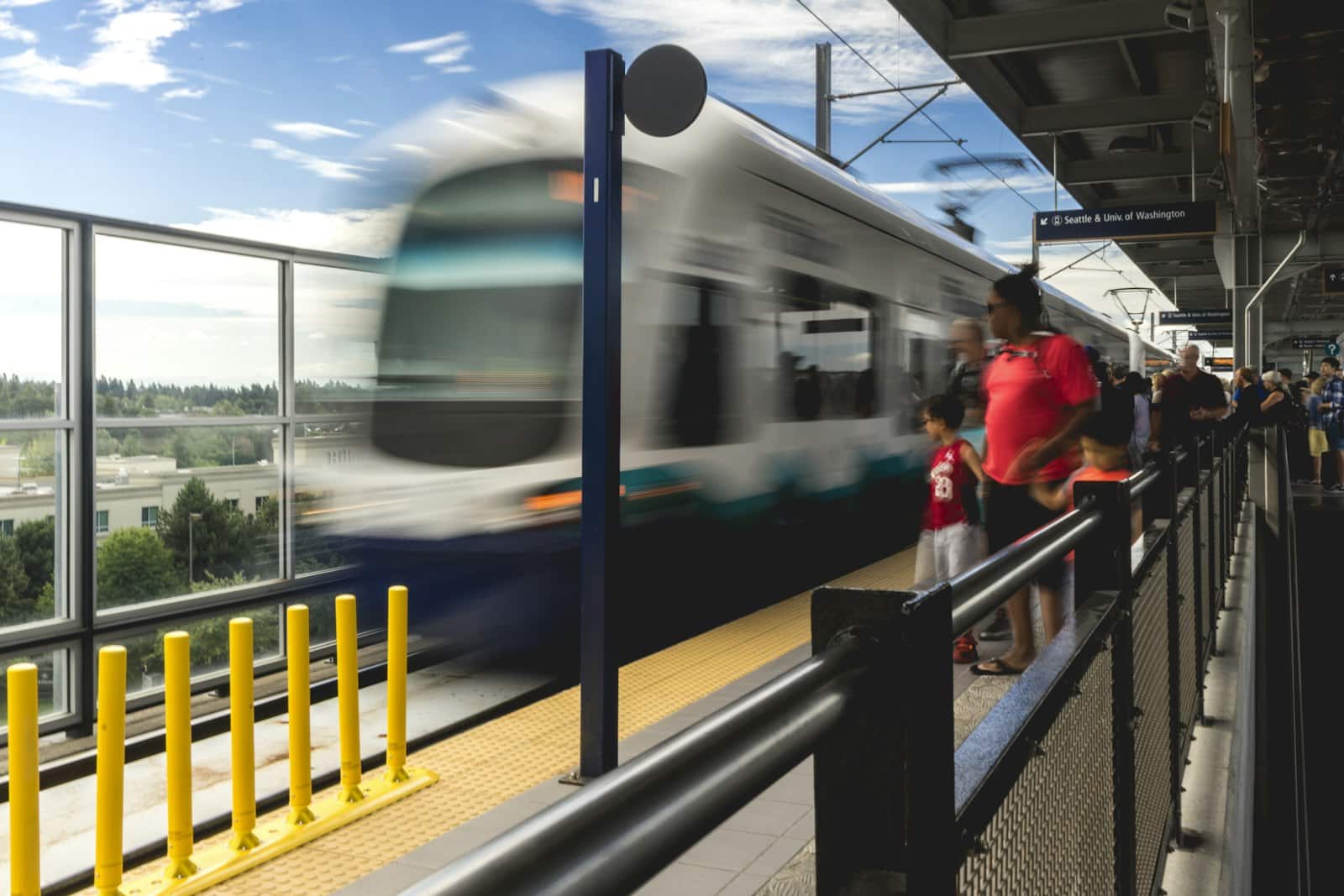
Rail is about the same size, and better used. MARTA runs 48 miles with 38 stations and carries about 152,000 riders a weekday. Link light rail runs 63 miles with 51 stations and, by Sound Transit’s counts reported this fall, carries more than 160,000 boardings a day. Both go to the airport. Link is newer, and more of the neighborhoods you’d want to live in sit on it. Since March 28, 2026 the 2 Line crosses Lake Washington, connecting Seattle with Mercer Island, Bellevue and Redmond, and extensions to West Seattle and Ballard are planned for the 2030s (we have opinions about Ballard’s). If you’ve thought about living without a car and never quite managed it in Atlanta, buy within a 15-minute walk of a Link station: Capitol Hill, the U District, Roosevelt, Northgate, Columbia City, Beacon Hill or downtown Bellevue and Redmond on the Eastside. The bus network does a lot of the work here, and plenty of our Capitol Hill clients use their cars less than once a week. Outside those corridors, you’ll want a car, and most households here have one.
If you’ll drive across the lake, I-90 is free and SR 520 is tolled in both directions: as of October 2026, up to $4.90 at weekday rush hour with a Good To Go pass and $6.90 if they mail you the bill. Your Peach Pass doesn’t work here. Good To Go is the Washington equivalent, and it also covers the SR 99 tunnel under downtown and the express lanes on I-405. One more thing: you’re three hours behind Atlanta now. A 9 a.m. call with the East Coast is a 6 a.m. call for you, and the markets open at 6:30.
If you’re transferring with Amazon, Microsoft, Google or another employer with offices in both cities, you already know the address. If you’re coming without a job, here’s the straight version. Atlanta’s economy is bigger and broader than Seattle’s: about 3.1 million jobs in the metro against 2.1 million here, per the Bureau of Labor Statistics, spread across logistics, corporate headquarters, healthcare, film and a growing tech scene. Seattle’s is narrower and tilts hard toward a few very large tech employers: the information sector is about 6% of jobs here against about 3% in Atlanta. Those employers have had a rough few years of their own. By our count, King and Snohomish counties added about 42,000 tech jobs from late 2019 to August 2022, then lost about 29,000 of them by early 2025. (We dug into what that’s doing to Eastside home prices in this post.) Where Atlanta experience lands here: software and cloud (obviously), logistics and the port, aerospace (Boeing, Blue Origin in Kent), healthcare (UW Medicine, Fred Hutch, Seattle Children’s and the big hospital systems). Where it doesn’t: film and television, which is a fraction of Georgia’s here, and corporate headquarters work outside of tech, because Seattle has fewer of them. My advice: get the offer letter before you sign a purchase agreement, and if you’re consulting, read the B&O paragraph above twice.
For schools, if you’re used to the APS versus Decatur versus north Fulton versus Gwinnett calculus being the reason a house costs what it does, Seattle is a little less stark. Seattle Public Schools assigns by address, and the Eastside cities have their own districts (Bellevue, Lake Washington for Kirkland and Redmond, Mercer Island, Issaquah and Northshore). Boundaries don’t follow neighborhood names, so check the district’s boundary lookup for the exact address before you offer.
A lot of families moving here rule out Seattle Public Schools on reputation alone and head straight for the Eastside, the way Atlanta families head north on 400. I think that’s often a mistake, and we wrote about why Seattle’s schools are better than their reputation. If you’re buying for the long haul, our post on Seattle’s sleeper schools covers the ones we think will improve the most.
Driver’s license. State law gives you 30 days after you move to get a Washington driver’s license, and you need it before you can register your car here.
Car registration. New residents also have 30 days to register their vehicles in Washington. No emissions test: Washington ended its program in 2020, so metro Atlanta’s annual inspection is behind you. In King County the bill includes Sound Transit and transit fees, so expect more than you’re used to paying for the tag.
Register to vote. Washington votes entirely by mail, so register at your new address and the ballot comes to you. Then cancel your Georgia registration.
Move the rest of your life. Change your address with your bank, brokerage and employer, and move your doctors when you can. Tell your employer’s payroll team the move date so your Georgia withholding stops. You’ll file a part-year Georgia return for the year you move.
Good To Go pass. If you’ll cross SR 520, use the SR 99 tunnel or the express toll lanes on 405, set up a Good To Go account before your first trip. Pay-by-mail costs $2 more per crossing on 520.
Fall maintenance. Gutters and roof moss are an annual thing here, the way the termite inspection and the pollen wash were there. Gutter cleaning runs about $200 to $500 and roof moss removal about $500 to $800 from Seattle companies.
Georgia is a landlord-friendly place to own a rental, Atlanta rents are solid relative to prices, and if you bought before 2022 your mortgage rate is probably low enough that the rent covers the payment. Plenty of people in your spot keep the house.

Before you do, here’s what keeping it means. The first thing you lose is the homestead exemption, and with it the floating caps that have been holding your assessment down. On a $400k house that takes the tax bill from about $4,900 to about $6,500 a year, and the assessment can be marked to market in one step. Georgia will tax the rent at 4.99% on a nonresident return. Insurance on a rental is its own policy, and in Georgia it isn’t cheap. Then the federal piece: the capital gains exclusion on your home sale requires that you lived there two of the last five years, so you have roughly three years after moving out before that window closes. And you’ll be managing a property from 2,600 miles away, three time zones off, in a market where homes are taking 64 days to sell, so if you ever need to get out quickly, you won’t. None of that makes it a bad idea. It means you should run the numbers with a CPA before you decide.
If you sell, the Georgia transfer tax is small, $1 per $1,000, about $400 on a $400k sale, and the seller is liable unless the contract shifts it. Timing matters more. Atlanta homes are taking about 64 days to sell and Seattle homes about 19, so your Atlanta sale will almost certainly take longer than your Seattle purchase. Offers contingent on selling another house are hard to win on Seattle houses that are drawing multiple offers. Most people in your spot either sell first and rent here for a bit, or line up a bridge loan with a lender who does them. Condos are the exception: King County had 7 months of condo inventory in October, so a condo buyer has more room to negotiate. (Our guide to the main loan types is a decent primer before you call a lender.) On the Washington side, the transfer tax (the real estate excise tax) is paid by the seller, so it won’t come up when you buy.
Buy or rent here? If you know where you’ll work and you’ve spent real time in a couple of neighborhoods, I think buying soon makes sense, because buyers have more room now than they did in 2025. If you don’t know the neighborhoods yet, rent for six months to a year, through a winter, and see whether the dark bothers you before you commit. If this is your first old house, our list of first-time buyer mistakes is worth a read even if it isn’t your first house.
For housing, much more. The median home in Seattle sold for about $864,000 over the three months ending in October 2026, versus about $400,000 in Atlanta, and Seattle costs twice as much per square foot ($539 versus $268). Rents are about $460 a month higher in Seattle. Washington has no income tax on wages, and homeowners insurance runs about half of Georgia’s average.
Georgia taxes income at a flat 4.99% in 2026, so a household with $250,000 of taxable income pays about $12,500 a year. Washington has no income tax on wages. Washington does tax long-term capital gains over $278,000 a year at 7%, with real estate exempt, and a 9.9% tax on household income over $1 million starts in 2028.
The bill is higher in Seattle, about $8,400 on the typical house versus about $4,900 on a $400,000 Atlanta homestead, because the house costs so much more. The rate is a little lower in Seattle, about 0.98% of market value against about 1.2% after Atlanta’s homestead exemptions, and Washington has no homestead exemption or floating cap.
No. Atlanta averages about 50 inches a year and Seattle about 39. Seattle spreads its rain over about 156 days as light drizzle from October through May, while Atlanta gets its rain on about 116 days, often in heavy storms. Seattle’s summers are dry, with an average July high of 77°F, and it gets about 570 fewer hours of sun a year.
It’s a little bigger. MARTA rail has 38 stations and about 152,000 weekday riders; Link light rail has 51 stations and more than 160,000 daily boardings. Both go to the airport. Link is newer, and since March 2026 it crosses Lake Washington to Bellevue and Redmond. If you want to live car-free, buy within a 15-minute walk of a Link station.
For Virginia-Highland, start with Wallingford or Phinney Ridge: 1910s and 1920s bungalows on a walkable grid with a main street of restaurants. For Decatur, look at Columbia City or Ravenna, which pair a small-town main street with well-regarded schools and a train downtown. If you liked Midtown, start with Capitol Hill.
No. Georgia requires a licensed attorney to close a real estate transaction. In Washington, escrow and title companies close most deals through Limited Practice Officers under Admission and Practice Rule 12. You can hire a lawyer if you want one, and on a complicated deal it’s worth it, but nothing requires it.
No. Washington contracts have negotiated contingencies (inspection, financing, title) rather than a free-look period, and winning offers on competitive houses often drop the inspection contingency. Buyers here usually inspect before they offer instead, and sellers must provide a statutory disclosure (Form 17, RCW 64.06.020) with three business days to rescind.
Maybe. Atlanta rents hold up well, but you’ll lose the homestead exemption and the floating caps, which takes a $400,000 house’s tax bill from about $4,900 to about $6,500, Georgia taxes the rent at 4.99%, and after roughly three years as a rental you can lose the federal home sale exclusion. Run the numbers with a CPA first.
If you’re planning a scouting trip, tell us when you’ll be in town and what you’re curious about. We’ll set up a learning tour across the neighborhoods that fit, with real cost numbers on the houses you see.
Coming from somewhere else? Start with our guide to moving to Seattle, which covers who moves here and what to expect wherever you’re coming from.
Disclaimer: This article is general information, not legal, tax or financial advice. Tax rules, ballot measures and market numbers change, and costs vary by house. Talk with your own CPA, attorney, inspector and contractor before making decisions.